
GCSE to US Credit Calculator
How GCSEs Translate to US Credits
This calculator helps you understand how your GCSE results translate to US high school credits and placement.
If you're moving from the UK to the US, or your child is switching school systems, you've probably asked: What is the GCSE equivalent in the US? It’s not a direct copy-paste. The US doesn’t have one single exam that matches the GCSE. But there’s a clear parallel in structure, timing, and purpose - and knowing it helps with school placement, college applications, and understanding academic expectations.
GCSEs Explained Simply
GCSEs - General Certificate of Secondary Education - are taken by students in England, Wales, and Northern Ireland around age 16, after 11 years of schooling. Most students take 8 to 10 subjects, including mandatory ones like English, Math, and Science. Grades range from 9 (highest) to 1 (lowest), with a 4 considered a standard pass and a 5 a strong pass. These exams aren’t just tests - they’re the first major academic milestone that shapes whether a student moves into A-Levels, vocational training, or work.
The US System Doesn’t Have One Big Exam
Unlike the UK, the US doesn’t have a national exam at age 16. There’s no single test that all students take across the country. Instead, the closest equivalent to GCSEs is the combination of end-of-course exams and high school credits earned by the end of 10th grade (sophomore year).
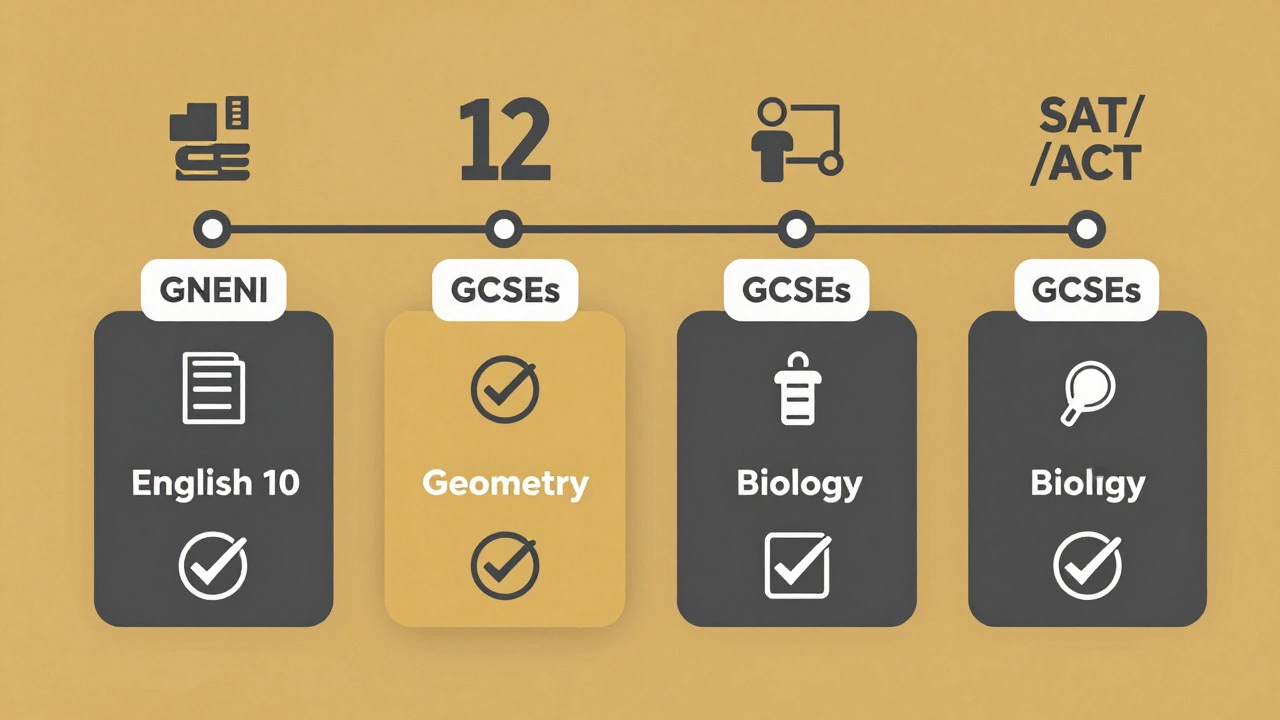
By the time a US student finishes 10th grade, they’ve typically completed core courses: English 10, Algebra I or Geometry, Biology or Physical Science, World History, and a foreign language (if required by their district). Each course ends with a final exam, and passing these - along with consistent classwork - earns them credits. These credits are recorded on their transcript and are what colleges and employers look at.
Think of it this way: Your child’s GCSE results in Biology, Chemistry, and Physics? In the US, that’s three separate high school science courses, each with its own final grade and credit. No single test covers all three. The assessment is spread out over two years.
What About Standardized Tests Like the SAT or ACT?
A lot of people assume the SAT or ACT is the US version of GCSEs. It’s not. Those tests come later - usually in 11th or 12th grade - and are used for college admissions, not for finishing high school. You can graduate high school in the US without ever taking the SAT.
GCSEs are about proving you’ve mastered a curriculum. The SAT measures general reasoning skills in Math and Evidence-Based Reading and Writing. They serve different purposes. One is a school completion requirement. The other is a college gatekeeper.
How US Schools Handle International Students with GCSEs
If a student moves to the US with GCSE results, schools don’t just say, “Oh, you passed 5 GCSEs, so you’re in 11th grade.” They look at the subjects, the grades, and how they line up with their own course offerings.
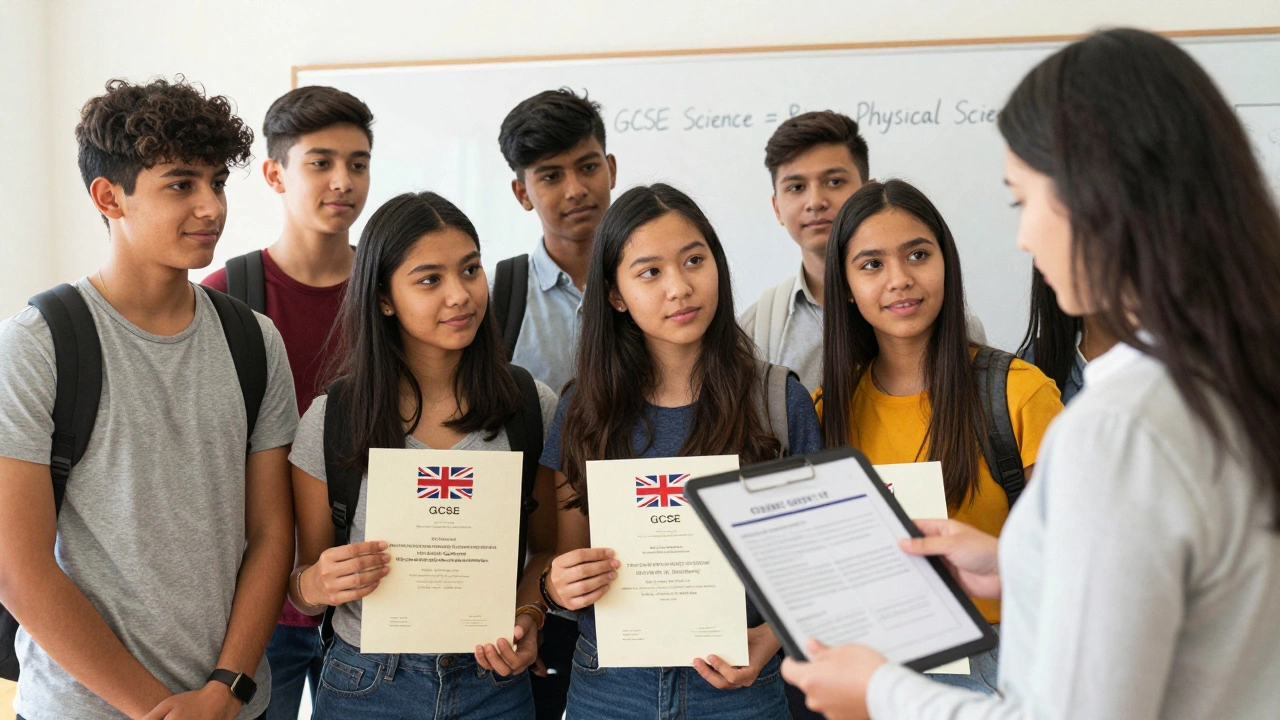
Most US high schools will place a student with 5 or more GCSEs at grade 10 or 11, depending on the subjects. For example:
- Passing GCSE English Language and Literature? That usually counts as completion of English 9 and 10.
- GCSE Math at grade 5 or higher? Often accepted as credit for Algebra I and sometimes Geometry.
- GCSE Science (Double Award)? May count as Biology and Physical Science credits.
Some schools require you to submit official transcripts with grading scales converted. Others may ask you to take a placement test in Math or English to confirm skill level. It’s not automatic - but it’s manageable.
What About Graduation Requirements?
Each US state sets its own rules for high school graduation. But most require around 20-24 credits across core subjects. Here’s a typical breakdown:
- English: 4 credits (4 years)
- Math: 3-4 credits (including Algebra I, Geometry, and Algebra II)
- Science: 3 credits (Biology, Chemistry, Physics - often with labs)
- Social Studies: 3-4 credits (US History, World History, Government)
- Foreign Language: 2 credits (sometimes optional)
- Electives: 5-8 credits (arts, tech, PE, etc.)
Compare that to GCSEs: 5-10 subjects taken at age 16. The US system spreads the same amount of content over four years, with more focus on depth and continuous assessment. That’s why a student with 5 GCSE passes might be placed in 10th grade - they’ve covered the first half of the US curriculum.
How Colleges View GCSEs
US colleges are used to international applicants. They don’t expect you to have taken the SAT or AP exams if you’re coming from the UK. They’ll look at your GCSE results as part of your academic record.
Top universities like Harvard, Stanford, or MIT don’t require A-Levels - they’ve accepted students with just GCSEs and strong extracurriculars. But for competitive programs, especially in STEM, they’ll want to see evidence of advanced study - like AS-Levels, A-Levels, or IB courses. GCSEs alone are seen as the foundation, not the finish line.
If you’re applying to US colleges with only GCSEs, make sure your transcript includes:
- Subject names exactly as listed
- Grades with the UK grading scale
- Official school stamp or signature
Many schools use services like WES (World Education Services) to convert UK grades to US equivalents. A grade 7 (A) is roughly an A in the US. A grade 4 (C) is a B- to C+.
What If You’re Homeschooling or Switching Systems Mid-Year?
Parents switching to homeschooling in the US after GCSEs often worry about accreditation. The good news: homeschooling laws vary by state, but most allow you to use GCSE results as proof of academic progress. You can submit them as part of your portfolio, especially if you’re aiming for a high school diploma.
Some online high schools - like Penn Foster or James Madison High School - accept GCSE credits toward their diploma programs. They’ll review your subjects and grades and tell you exactly what you still need to complete.
Key Takeaways
- The US doesn’t have a direct GCSE equivalent - it’s a system of credits earned over 10th grade.
- GCSEs are roughly equivalent to the coursework completed by the end of 10th grade in the US.
- SAT and ACT are not equivalents - they’re college entrance exams taken later.
- US schools use GCSE results to place students in the right grade level and grant course credits.
- Colleges accept GCSEs as part of your academic record, especially when paired with higher-level qualifications.
What Comes After GCSEs in the US?
If you’re thinking ahead: after GCSEs, UK students often take A-Levels. In the US, the equivalent path is taking Advanced Placement (AP) courses or International Baccalaureate (IB) classes in 11th and 12th grade. These are the real college-level exams that US universities look for.
So while GCSEs get you into the next phase, APs and IBs are what open the door to top colleges. If you’re planning to study in the US after GCSEs, aim to take at least two AP or IB subjects before applying.
Final Thought
There’s no magic number or test that says “GCSE = US High School Diploma.” But if you understand the structure - course credits, subject coverage, and timing - you can navigate the system confidently. Whether you’re moving, transferring, or just curious, the key is matching subjects and grades, not searching for a one-to-one label.
Is a GCSE the same as a high school diploma in the US?
No. A GCSE is not a diploma - it’s a set of subject exams taken at age 16. The US high school diploma is earned after completing four years of coursework, typically by age 18. GCSEs are roughly equivalent to the coursework completed by the end of 10th grade in the US system.
Can I use my GCSEs to get into a US college?
Yes, but GCSEs alone are usually not enough for competitive colleges. Most US universities expect students to have completed higher-level qualifications like A-Levels, IB, or AP courses. GCSEs are seen as foundational. If you’re applying with only GCSEs, you’ll need strong extracurriculars, personal statements, and possibly additional testing like the SAT or ACT.
Do US high schools accept GCSE grades for credit?
Yes, most US public and private high schools will evaluate GCSE results and grant course credits based on subject and grade. A grade 6 or higher in English, Math, or Science typically translates to full credit for those courses. Schools may ask for official transcripts and sometimes require placement tests to confirm skill level.
What’s the US equivalent of a GCSE grade 5?
A GCSE grade 5 is considered a strong pass and is generally equivalent to a B- to B+ in the US grading system. It’s above average and meets most college preparatory requirements. For example, a grade 5 in Math would likely satisfy the Algebra I or Geometry requirement in a US high school.
Do I need to take the SAT if I have GCSEs?
Not for high school graduation - but yes, if you want to apply to most US colleges. The SAT or ACT is required for undergraduate admissions, even if you have GCSEs or A-Levels. These tests help colleges compare students from different education systems. Some schools are test-optional, but having scores can strengthen your application.