
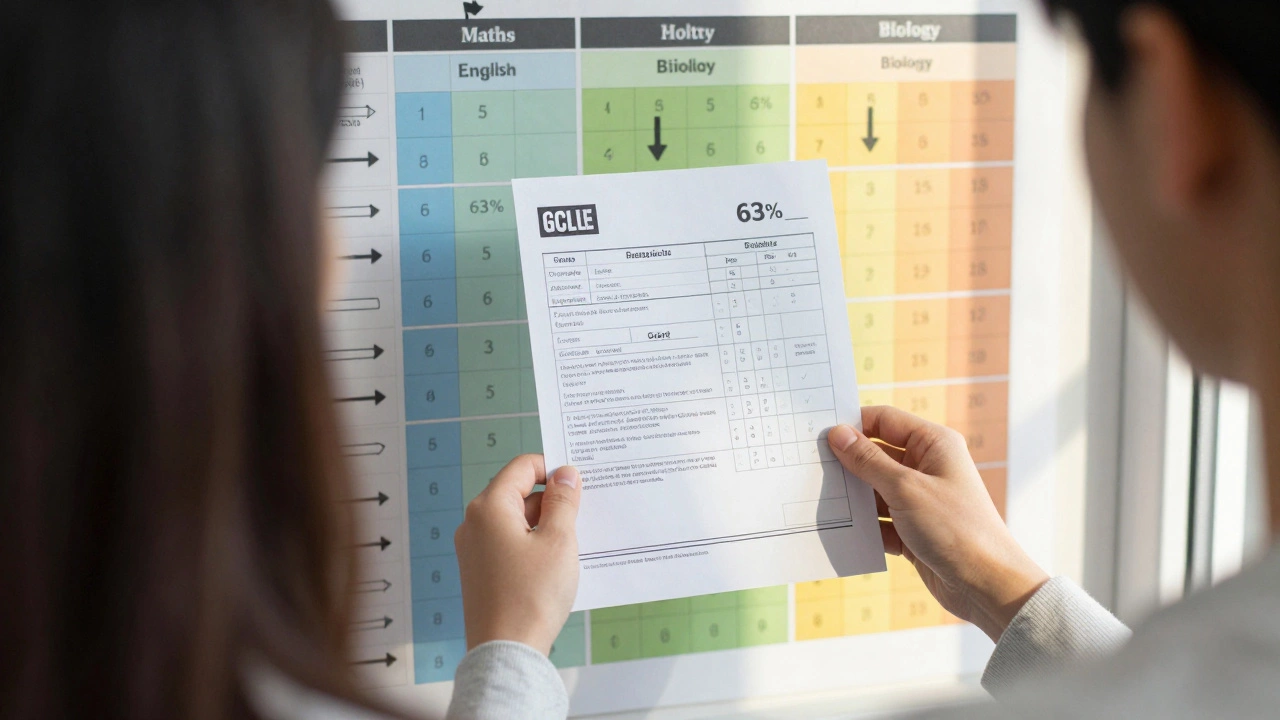
GCSE Grade Boundary Calculator
Enter your percentage score and select your subject to see which GCSE grade you likely achieved based on typical boundaries.
Enter your score and subject to see your likely grade
Getting 63% on a GCSE paper doesn’t tell you much unless you know how the grading system works. Many students think a score like this is just above average, but in GCSE terms, it could mean a solid grade 5 or even a high grade 4. It all depends on the subject, the exam board, and the year’s difficulty. There’s no fixed rule that says 63% equals a specific grade - and that’s where confusion starts.
How GCSE Grading Works Now
Since 2017, GCSEs in England use a 9 to 1 grading scale, replacing the old A* to G system. Grade 9 is the highest, above the old A*, and grade 1 is the lowest passing grade. A grade 4 is considered a standard pass, and a grade 5 is a strong pass. Most schools and employers look for at least a grade 5 in English and Maths.
Grades aren’t based on fixed percentages. Each subject sets its own boundaries every year, depending on how students performed overall. If a paper was unusually hard, the grade boundaries drop. If it was easy, they rise. That’s why a 63% in one subject might be a grade 7, but in another, it could be a grade 5.
What 63% Usually Means in Practice
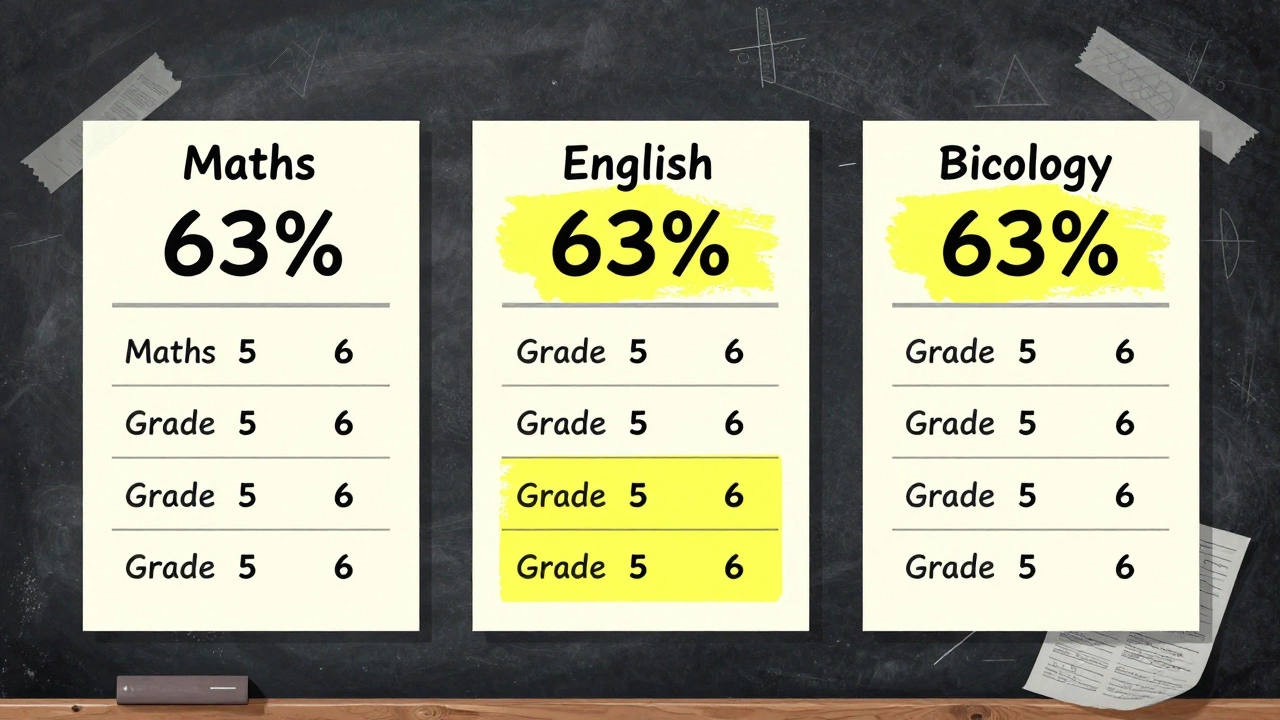
Looking at past data from AQA, Edexcel, and OCR, a score around 63% typically lands you between a grade 5 and a grade 6. For example:
- In GCSE Maths (2024), 63% was around a grade 6. The boundary for a grade 5 was 54%, and for a grade 6 it was 64%.
- In GCSE English Language (2023), 63% was a high grade 5 - just below the grade 6 boundary at 65%.
- In GCSE Biology (2024), 63% was a solid grade 6, with grade 5 starting at 58%.
So while 63% isn’t a guaranteed grade 6, it’s very close. In most subjects, it’s a strong pass - and often enough to get into sixth form or college.
Why the Same Percentage Can Mean Different Grades
Not all GCSEs are created equal. Some subjects are graded more harshly because they’re considered more difficult or have higher entry standards. For instance:
- Maths and Sciences often have tighter grade boundaries. A few extra marks can push you from a 5 to a 6.
- Subjects like Art, Drama, or Media Studies use more coursework and teacher assessment. A 63% exam score might be balanced by high coursework marks, lifting your final grade.
- Foundation tier papers (for students aiming for grades 1-5) have lower overall boundaries. A 63% on a foundation paper could be a grade 4 or even 5, but you can’t get above a grade 5 no matter how well you do.
That’s why you can’t just look at a percentage and know your grade. You need to see the official grade boundaries for your specific subject and exam board.
How to Find Your Exact Grade Boundary
The exam boards publish grade boundaries after results day. You can find them on their websites:
- AQA: aqa.org.uk/exams-administration/results-day
- Edexcel: pearsonqualifications.com/results
- OCR: ocr.org.uk/results
Look for the June 2025 or November 2025 grade boundaries (depending on when you sat your exam). You’ll see a table showing the minimum marks needed for each grade. For example:
| Grade | Minimum Marks |
|---|---|
| 9 | 84 |
| 8 | 74 |
| 7 | 65 |
| 6 | 56 |
| 5 | 47 |
| 4 | 38 |
In this case, 63% would be a grade 7. But if you took the same paper in a harder year, the boundary for a grade 7 might jump to 67%. That’s why last year’s data is only a guide.
What Should You Do If You Got 63%?
If you’re waiting for results, don’t panic. 63% is usually a good score. Here’s what to do next:
- Find out which exam board and tier you took (higher or foundation).
- Look up last year’s grade boundaries for your subject on the exam board’s website.
- Compare your mark to the 2024 or 2023 boundaries as a rough estimate.
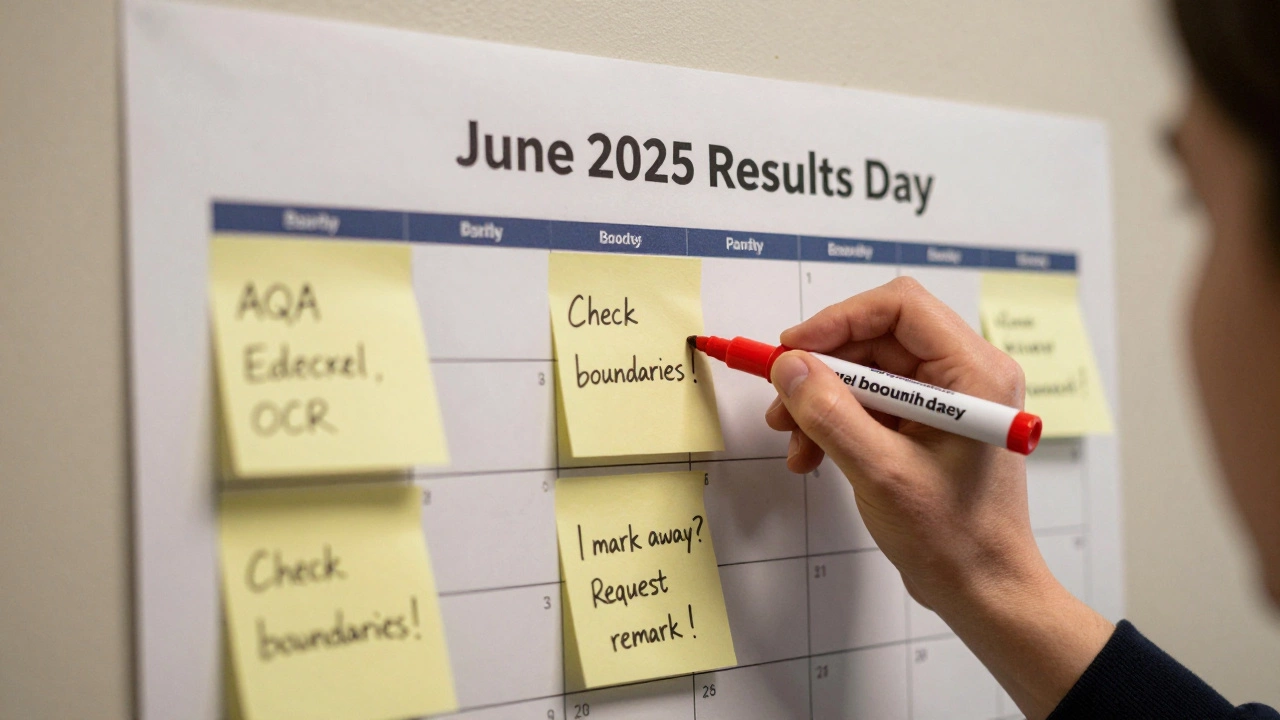
- If you’re close to the next grade, consider requesting a remark - but only if you’re within 1-3 marks of the boundary.
- Use your results to plan your next steps: sixth form, college, apprenticeships, or retakes.
Many students who score 63% end up with a grade 5 or 6 - which is more than enough for most A-level courses and vocational programs.
Common Myths About GCSE Percentages
There are a lot of myths floating around:
- Myth: 63% always means a grade 6.
Reality: It depends on the subject and year. In 2022, 63% in History was a grade 5. - Myth: You need 70% to get a grade 7.
Reality: In some years, grade 7 has been awarded at 62%. - Myth: A grade 4 is a fail.
Reality: A grade 4 is a standard pass. You’ve passed. Many jobs and colleges accept it.
Don’t let myths make you feel like you’ve failed. 63% is a strong result in most contexts.
How to Use This Info for Future Exams
If you’re preparing for next year’s GCSEs, use past papers and grade boundaries to set realistic targets. For example:
- If you want a grade 6 in Chemistry, aim for at least 65% on practice papers based on last year’s boundary.
- Track your scores over time. If you’re consistently scoring 60-65%, you’re on track for a grade 5 or 6.
- Focus on weak areas. A few extra marks in a topic like equations or essay structure can push you over the line.
Don’t just chase percentages - chase understanding. The more confident you are with the material, the less you’ll worry about the exact mark.
What If You’re Close to a Grade Boundary?
If you’re only 1-3 marks away from a higher grade, you can request a remark. This means your paper is re-marked by a different examiner. There’s a small fee, but if your grade goes up, you get the money back.
It’s worth it if:
- You’re 1 mark off a grade 5 and need it for college entry.
- You’re 2 marks off a grade 6 and want to take A-levels.
- You’re confident you did better than your mark suggests.
But don’t request a remark just because you’re disappointed. If you’re 10 marks away, it’s unlikely to change anything.
Final Thoughts: 63% Is Not a Failure
Too many students think grades are everything. But a 63% means you understood most of the content, could answer most questions correctly, and showed solid knowledge. That’s not bad - it’s actually above average.
GCSEs are just one step. What matters more is what you do next. If you got 63%, you’ve proven you can handle the workload. Now use that momentum to keep improving.
Is 63% a pass at GCSE?
Yes, 63% is well above the minimum pass mark. A grade 4 (standard pass) usually requires around 40-45%, depending on the subject. A 63% score typically puts you in grade 5 or 6, which is a strong pass.
Can I get a grade 7 with 63%?
It’s possible, but unlikely in most subjects. Grade 7 boundaries are usually between 65% and 70%. However, in harder years or less competitive subjects like Religious Studies, a 63% could be a grade 7. Check the official boundaries for your subject.
Why does GCSE grading change every year?
GCSE grade boundaries are adjusted each year to account for exam difficulty and student performance. If a paper was unusually hard, the boundaries drop so students aren’t penalized. If it was easy, they rise to maintain standards. This keeps grades consistent over time.
Is a grade 5 better than a grade 4?
Yes. A grade 5 is considered a strong pass, while a grade 4 is a standard pass. Many sixth forms and colleges require at least a grade 5 in English and Maths. Employers also often prefer grade 5s.
Do I need to retake if I got 63%?
No, unless you need a higher grade for your next step. A 63% usually gives you a grade 5 or 6, which is enough for most A-level courses, apprenticeships, and jobs. Only retake if you’re aiming for a specific grade required by a college or career path.