
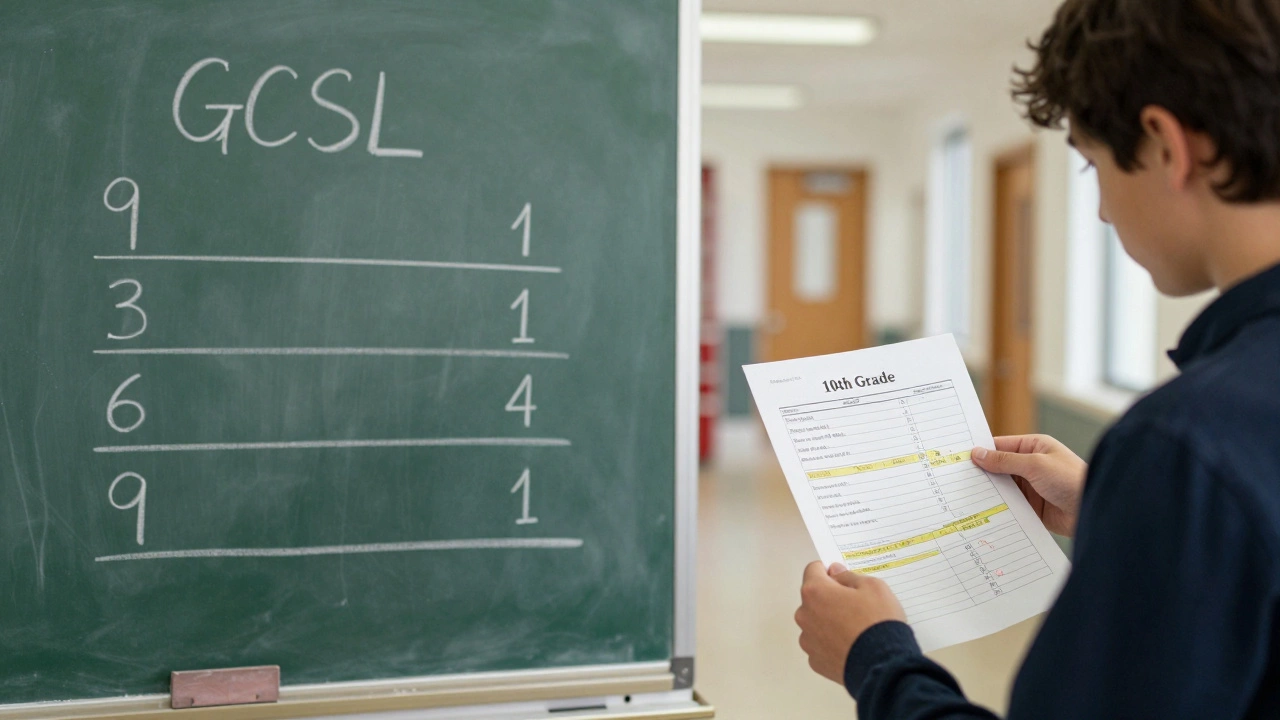
GCSE to US Grade Equivalent Calculator
GCSE Grade Converter
This tool converts GCSE grades to equivalent US high school grade levels based on academic standards and college admission requirements.
US Grade Equivalent
Important Note
GCSEs are equivalent to the end of 10th grade in the US system, but are not sufficient for college admission. US universities require completion of 12th grade through programs like A Levels, IB, or AP courses.
If you’re looking at GCSEs and wondering how they line up with the American education system, you’re not alone. Thousands of international students, families, and even employers need to understand this comparison every year. The short answer? GCSEs are most similar to the end of 10th grade in the U.S.-but the full picture is more detailed than that.
What Exactly Are GCSEs?
GCSE stands for General Certificate of Secondary Education. These are the exams most students in England, Wales, and Northern Ireland take around age 16, after two years of study. Students usually take between 8 and 10 subjects, including core ones like English, Maths, and Science, plus options like History, Art, or Computer Science. Grades range from 9 (highest) to 1 (lowest), with a 4 considered a standard pass and a 5 a strong pass.
Unlike American high school, where grades are based on continuous assessment throughout the year, GCSEs are mostly decided by final exams. That makes them a more standardized measure of what a student knows at the end of compulsory education.
How GCSEs Compare to U.S. High School
In the U.S., students don’t take a single national exam at the end of 10th grade. Instead, they earn credits by passing individual courses. By the end of 10th grade, most American students have completed:
- English Language Arts (2 years)
- Algebra I and often Geometry (Math)
- Biology and Physical Science (Science)
- World History and U.S. History (Social Studies)
- Physical Education and electives (Art, Music, Foreign Language)
So, if you’ve passed your GCSEs, you’ve covered roughly the same subjects as a U.S. student finishing 10th grade. But here’s the catch: GCSEs are more exam-focused and often more rigorous in content depth, especially in Maths and Sciences.
GCSEs vs. High School Diploma
Many people ask: “Is a GCSE the same as a U.S. high school diploma?” The answer is no. A U.S. high school diploma is earned after completing 12th grade-two full years beyond GCSEs. That means GCSEs are closer to halfway through American high school.
Here’s a clearer breakdown:
| UK System | U.S. Equivalent | Age |
|---|---|---|
| Year 10 | 10th Grade | 15-16 |
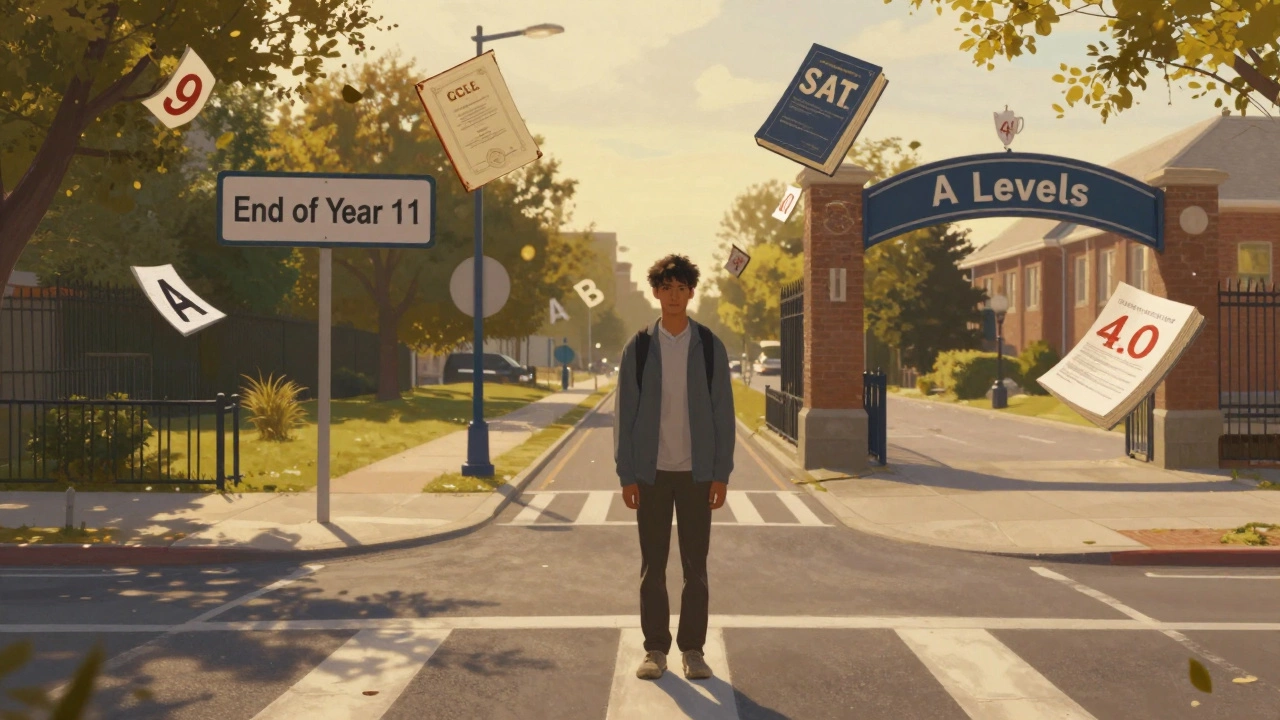
| GCSE Exams (End of Year 11) | End of 10th Grade | 15-16 |
| AS Levels (Year 12) | 11th Grade | 16-17 |
| A Levels (Year 13) | 12th Grade | 17-18 |
| - | High School Diploma | 17-18 |
So while a GCSE isn’t a diploma, it’s a solid indicator that a student has reached the academic level of a U.S. 10th grader. Colleges and employers in the U.S. understand this and often treat GCSE results as part of a broader academic record.
What About College Admissions?
If you’re applying to a U.S. college with GCSEs, you’ll need more than just those results. American universities expect a full high school transcript covering grades 9 through 12. That means you’ll need to continue with A Levels, the International Baccalaureate (IB), or a similar pre-university program.
For example, a student with 5 GCSEs at grade 7 or higher (including English and Maths) and then three A Levels at grades A-B is seen as competitive for many U.S. colleges. Some schools even ask for SAT or ACT scores on top of that.
It’s not uncommon for U.S. admissions officers to convert GCSE grades to a U.S. GPA scale. A grade 7 (A) is often treated as an A (4.0), a grade 6 (B) as a B (3.0), and so on. But they’ll always look at the full context: how many subjects you took, whether you studied challenging ones, and what you did after GCSEs.

What If You Only Have GCSEs?
Some people finish their GCSEs and then move to the U.S. without continuing to A Levels. In that case, you might need to complete a GED (General Educational Development) test to prove you have the equivalent of a U.S. high school diploma.
The GED covers five subjects: Math, Science, Social Studies, Reading, and Writing. It’s designed for adults who didn’t finish high school. If you’ve passed your GCSEs, you’re likely well-prepared for the GED-especially in Maths and English. Many community colleges in the U.S. accept the GED for admission.
Do U.S. Colleges Accept GCSEs Alone?
Not usually. But there are exceptions. Some U.S. universities, especially those with international programs or early admission pathways, will look at GCSE results as part of a portfolio for younger students. For example, a 16-year-old applying to a summer program or a pre-college course might use GCSEs to show academic readiness.
However, for full-time undergraduate admission, you’ll need to have completed at least 11th grade-level coursework. That means A Levels, IB, AP courses, or an equivalent.
How to Get Your GCSEs Recognized in the U.S.
If you’re planning to move to the U.S. for school or work, here’s what you should do:
- Request official transcripts from your school or exam board (like AQA, Edexcel, or OCR).
- Get your documents evaluated by a credential service like WES (World Education Services) or ECE (Educational Credential Evaluators).
- These services will convert your GCSE grades into U.S. equivalents and provide a report schools or employers can trust.
- Pair your GCSEs with any further qualifications (A Levels, IB, etc.) to show progression.
Many students don’t realize this step is needed. Without an official evaluation, U.S. institutions may not know how to interpret your grades.
Why This Matters for International Students
If you’re from the UK and applying to a U.S. college, understanding this conversion helps you present yourself clearly. You can say, “I completed my GCSEs with 8 subjects at grade 7+, including English and Maths,” instead of just listing grades that might confuse admissions officers.
It also helps when applying for scholarships. Some U.S. scholarships require proof of academic standing equivalent to a U.S. high school student. Knowing how GCSEs fit into that system makes your application stronger.
What About Other Countries?
GCSEs are also compared to qualifications in Canada, Australia, and New Zealand. In Canada, they’re roughly equivalent to Grade 10. In Australia, they’re similar to the end of Year 10, before starting the HSC or VCE. But the U.S. system is unique because it doesn’t have a single national exam-so comparisons are always approximate.
That’s why credential evaluation services exist. They don’t guess-they follow official guidelines from U.S. education departments and universities.
Bottom Line: GCSEs Are a Strong Foundation
GCSEs aren’t the end of the road in the U.S. system-they’re the midpoint. They prove you’ve mastered core subjects at a level comparable to a U.S. 10th grader. But to get into a U.S. university, you’ll need to go further: take A Levels, IB, AP, or complete your high school education.
Don’t assume your GCSEs will be automatically understood. Get them officially evaluated. Keep your transcripts. Build on them with more advanced study. And remember: many successful international students started exactly where you are now-with GCSEs in hand and a plan to go further.
Are GCSEs accepted by U.S. colleges?
U.S. colleges don’t accept GCSEs alone for undergraduate admission. They require completion of a full high school curriculum, usually through A Levels, IB, AP courses, or a U.S.-style high school diploma. GCSEs are seen as part of your academic background, not a standalone qualification.
What U.S. grade level is a GCSE equivalent to?
GCSEs are most closely equivalent to the end of 10th grade in the U.S. high school system. Students in the U.S. take similar subjects-English, Math, Science, History-by age 15-16, but they continue for two more years before earning a diploma.
Can I use GCSEs to get into community college in the U.S.?
Some community colleges may accept GCSEs along with a GED or proof of equivalent study. However, most will still require you to complete a high school equivalency test like the GED, especially if you’re under 18. It’s best to contact the college directly with your transcripts.
Do I need to take the SAT or ACT if I have GCSEs?
Yes, most U.S. universities still require SAT or ACT scores-even for international students with GCSEs and A Levels. These tests help standardize comparisons across different education systems. Some schools are test-optional, but having scores can strengthen your application.
How do I convert my GCSE grades to a U.S. GPA?
There’s no official formula, but most credential evaluators use this general guide: Grade 9 = A+ (4.0), Grade 8 = A (4.0), Grade 7 = A- (3.7), Grade 6 = B (3.0), Grade 5 = B- (2.7), Grade 4 = C (2.0). Always get your grades evaluated by a recognized service like WES for official use.
If you’re planning your next steps after GCSEs, remember this: the U.S. system values progression. It’s not just about what you’ve done-it’s about what you’re doing next. Keep building your academic record, and your GCSEs will be a strong starting point.