

Andragogy Self-Assessment
Test your knowledge on how adults learn best. Are you leveraging the power of experience, autonomy, and immediate application?
You’ve probably noticed that how you learn a new skill today feels completely different from how you learned algebra in high school. Back then, you sat still, listened to a lecture, and memorized facts for a test. Now, if you’re trying to pick up Python coding or project management skills, you likely want to know why it matters before you start, and you want to apply it immediately. This shift isn’t just about being busy; it’s rooted in a specific educational framework called Andragogy, which is the method and practice of teaching adult learners, distinguished by their self-direction and experience-based approach.
Understanding the fundamentals of adult learning helps you stop fighting your brain’s natural preferences. Instead of forcing yourself into child-like learning models, you can leverage your life experience to absorb information faster. Let’s break down what actually makes adult learning tick, why traditional schools often fail adults, and how you can use these principles to master any subject.
The Core Difference: Pedagogy vs. Andragogy
To understand adult learning, you first need to see what it isn’t. Most people are trained in Pedagogy, the art and science of teaching children, where the teacher directs all learning activities. In pedagogy, the learner is dependent on the instructor. The curriculum is fixed, the pace is set by the class average, and motivation is usually external-grades, parental approval, or fear of failure.
Andragogy flips this script. Developed prominently by educator Malcolm Knowles in the 1970s, it assumes that as humans mature, they move toward greater psychological independence. Adults don’t want to be "taught" in the passive sense; they want to be facilitated. They bring a massive library of prior experiences to the table, which serves as both a resource and a filter for new information.
| Feature | Pedagogy (Child-Centered) | Andragogy (Adult-Centered) |
|---|---|---|
| Learner Self-Concept | Dependent personality | Self-directed, autonomous |
| Role of Experience | Minimal resource; primary source is teacher/textbook | Rich resource; basis for new learning |
| Readiness to Learn | Determined by curriculum schedule | Linked to social/professional roles |
| Orientation to Learning | Subject-centered (future application) | Problem-centered (immediate application) |
| Motivation | External (grades, praise) | Internal (self-esteem, quality of life) |
Knowles’ Five Assumptions of Adult Learners
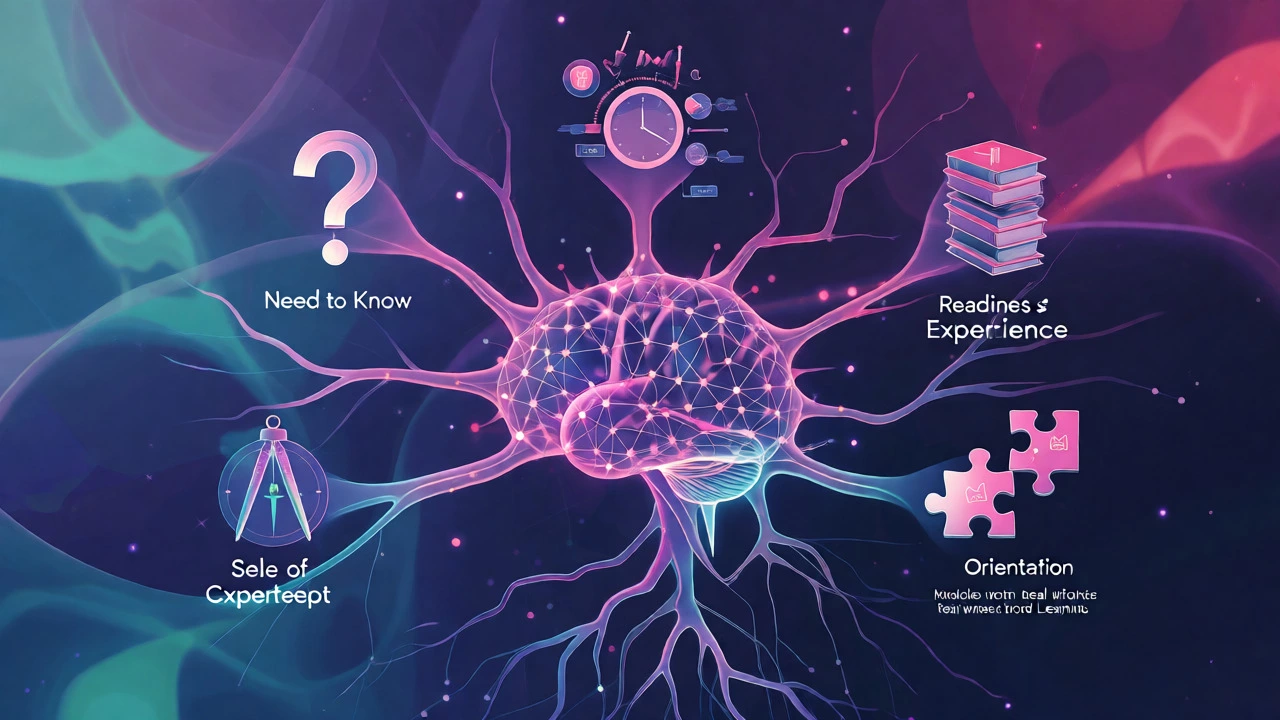
Malcolm Knowles didn’t just guess at how adults learn; he built a model based on five key assumptions. If you ignore these, you’ll struggle to retain information. Here is what they mean for you practically.
1. The Need to Know
Children often learn things because they are told to. Adults need to know why they need to learn something before engaging with it. If you are taking a course on data analytics, you won’t stick with it unless you clearly see how it solves a problem at work or helps you get a promotion. Without a clear purpose, adult attention spans drop rapidly.
2. Self-Concept
As we age, we develop a deep-seated need to be seen as capable and self-directing. When an adult learner feels treated like a child-passive, unable to make choices-they resist. Effective adult learning respects autonomy. You should have control over the pace, the method, and often the content of your study.
3. The Role of Experience
This is the superpower of adult learners. Your past jobs, hobbies, and failures create mental hooks. New information sticks better when you can attach it to something you already know. For example, if you’re learning about supply chain logistics, you’ll grasp it faster if you connect it to a time you waited weeks for a delayed package. Ignoring your experience wastes your most valuable cognitive asset.
4. Readiness to Learn
Adults become ready to learn when they encounter a task or role that requires new knowledge. You don’t study tax law because it’s interesting; you study it because you just started a business. This "teachable moment" means timing is everything. Learning is most effective when it aligns with immediate life transitions.
5. Orientation to Learning
Children learn subjects in isolation (math, history). Adults prefer problem-centered learning. They want to solve real-world issues. If you’re learning Spanish, you don’t care about conjugation tables in theory; you care about ordering food without embarrassment. Focus on solving problems, not collecting facts.
Why Traditional Schools Fail Adults
Many online courses and corporate training programs still use pedagogical methods, which explains why completion rates for MOOCs (Massive Open Online Courses) hover around 5-15%. Why do adults quit?
- Too much theory, too little practice: Adults want to apply knowledge immediately. A four-hour lecture on communication theory feels useless compared to a 20-minute workshop on handling difficult client emails.
- Lack of relevance: If the content doesn’t address a current pain point, the adult brain filters it out as noise.
- Passive delivery: Sitting in a webinar listening to a speaker ignores the adult’s need for interaction and contribution.
- Ignoring prior knowledge: Starting from scratch insults the learner’s intelligence. Adults hate repeating what they already know.
When you design your own learning path, avoid these traps. Seek out resources that offer hands-on projects, case studies, and immediate feedback loops.
Practical Strategies for Effective Adult Learning
So, how do you actually apply these fundamentals? You don’t need a degree in psychology to optimize your brain. Here are actionable steps based on andragogical principles.
Leverage Your Experience
Before diving into a new topic, write down three questions you already have about it. Connect new concepts to old memories. If you’re learning about leadership styles, think about the best and worst bosses you’ve had. Analyze them through the new lens. This process, known as Experiential Learning, involves learning through reflection on doing.
Make It Immediate
Adopt a "learn, then do" cycle. Don’t wait until you finish a whole module to try something out. If you read a tip on public speaking, record yourself giving a one-minute talk today. The gap between input and output should be hours, not weeks. This reinforces neural pathways while the information is fresh.
Take Ownership
Stop waiting for permission. Define your own success metrics. Instead of saying, "I want to learn French," say, "I want to be able to hold a 5-minute conversation with my neighbor by next month." Set your own deadlines and choose your own resources. Autonomy boosts motivation significantly.
Find Community
While adults are self-directed, they aren’t isolated. Peer learning is powerful. Join forums, study groups, or professional networks related to your topic. Discussing ideas with others who share similar contexts helps clarify misunderstandings and provides social validation, which sustains long-term effort.
The Role of Technology in Modern Andragogy
Technology has changed the landscape of adult learning, but only if used correctly. Platforms like Coursera, LinkedIn Learning, and even YouTube allow for the self-paced, modular consumption of content that suits adult schedules. However, tech can also lead to passive consumption-watching videos without practicing.
Use technology to facilitate active learning. Use apps like Anki for spaced repetition, which works well for vocabulary or technical terms. Use collaborative tools like Notion or Trello to track your progress and organize projects. Remember, the tool should serve your goal, not distract from it. The fundamental principle remains: the learner must be active, not passive.

Overcoming Common Barriers
Even with the right mindset, adults face unique hurdles. Time scarcity is the biggest one. Many adults juggle jobs, families, and personal lives. The solution isn’t finding more time-it’s integrating learning into existing routines. Listen to podcasts during commutes, read articles during lunch breaks, or practice skills during downtime.
Fear of failure is another barrier. Adults often worry about looking incompetent. Remember that everyone starts as a beginner. Embrace the discomfort. Mistakes are data points, not judgments of character. In adult learning, resilience matters more than raw talent.
Finally, there’s the trap of perfectionism. Adults often want to master everything before moving on. But in a fast-changing world, "good enough" is often better than perfect. Aim for proficiency, not mastery, in the early stages. You can always deepen your knowledge later.
Key Takeaways
- Shift your mindset: Stop acting like a student in a classroom. Start acting like a consultant solving a problem.
- Connect to context: Always ask "How does this help me right now?" If you can’t answer, skip the material.
- Respect your experience: Use your past knowledge as a foundation, not a hurdle.
- Be active: Reading and watching are passive. Doing and creating are active. Prioritize the latter.
- Control your path: Choose what, when, and how you learn. Autonomy fuels persistence.
Adult learning isn’t about returning to school; it’s about adapting to a world where change is constant. By understanding the fundamentals of andragogy, you take control of your education. You stop wasting time on irrelevant lectures and start building skills that matter. The next time you pick up a book or sign up for a course, remember: you are not a vessel to be filled, but a fire to be kindled.
Is andragogy applicable to all adults?
Not exactly. While the principles of andragogy apply broadly, individual differences exist. Some adults may prefer more structured guidance due to anxiety or lack of confidence. Additionally, highly specialized fields may require strict pedagogical foundations initially before allowing for self-directed exploration. It’s a spectrum, not a binary switch.
Can I use adult learning principles for corporate training?
Absolutely. Corporate training fails most often when it ignores adult learning principles. To improve engagement, trainers should focus on problem-solving scenarios, respect employees' expertise, and link training directly to job performance goals. Gamification and peer-to-peer coaching also align well with andragogical methods.
How do I stay motivated as an adult learner?
Motivation for adults is largely intrinsic. To sustain it, ensure your learning goals are personally meaningful. Break large goals into small, achievable milestones to maintain momentum. Celebrate small wins. Also, consider accountability partners or public commitments, as social pressure can supplement internal drive.
Does age affect the ability to learn new skills?
Neuroplasticity persists throughout life, so adults can absolutely learn new skills. However, processing speed and working memory may decline slightly with age, while crystallized intelligence (knowledge base) increases. Adults compensate by using strategies, context, and experience to bridge gaps, often leading to deeper understanding despite slower initial acquisition.
What is the biggest mistake adults make when learning?
The biggest mistake is passive consumption. Adults often binge-watch tutorials or read books without applying the knowledge. Another common error is ignoring the "why"-starting a course without a clear, immediate benefit in mind leads to abandonment when the novelty wears off.