
GCSE to US GPA Converter
Convert your GCSE grades to US GPA equivalents to understand how your qualifications compare when applying to colleges in the United States.
Your GCSE Grades
Results
Note: This is a general conversion tool. US colleges consider multiple factors beyond GPA including SAT/ACT scores, extracurricular activities, and essays.
If you’ve heard about GCSEs and are wondering what they’re like in the U.S., you’re not alone. Millions of international students and parents ask this every year. The short answer? There’s no exact one-to-one match. But there’s a clear parallel - and understanding it can help you compare grades, plan for college, or even transfer schools between the UK and the U.S.
What Are GCSEs, Anyway?
GCSE stands for General Certificate of Secondary Education. It’s the main qualification taken by students in England, Wales, and Northern Ireland around age 16, after two years of study. Most students take between 8 and 10 subjects - things like Math, English, Science, History, and a foreign language. Each subject ends with exams, and grades range from 9 (highest) to 1 (lowest), with a 4 considered a standard pass and a 5 a strong pass.
These aren’t just end-of-year tests. GCSEs shape what you can do next. If you don’t pass core subjects like English and Math, you’ll have to retake them. Colleges and employers look at these grades closely. They’re the foundation for A-Levels, apprenticeships, or vocational training.
The U.S. Equivalent: High School Diploma and End-of-Course Exams
In the U.S., students don’t take one standardized exam at age 16 like GCSEs. Instead, they earn a high school diploma by completing a set of required courses over four years - typically from ages 14 to 18. Each state sets its own rules, but most require:
- 4 years of English
- 3-4 years of Math (including Algebra and Geometry)
- 3 years of Science (Biology, Chemistry, Physics)
- 3 years of Social Studies (History, Government, Economics)
- 1-2 years of a Foreign Language
- Electives (Arts, Technology, PE)
At the end of each course, students take final exams. These aren’t national like GCSEs - they’re created by schools or districts. Some states have exit exams, like California’s CAASPP or New York’s Regents Exams, which are more like GCSEs in structure. But even then, they’re just one part of your overall grade.
Comparing GCSEs to U.S. High School Credentials
Let’s make this real. Say you got a grade 6 in GCSE Biology. What does that mean in the U.S.?
It’s roughly equivalent to a B average in a U.S. high school biology course. But here’s the catch: U.S. schools don’t have a single national score. Instead, colleges look at your transcript - your grades across all subjects over four years - and your SAT or ACT scores.
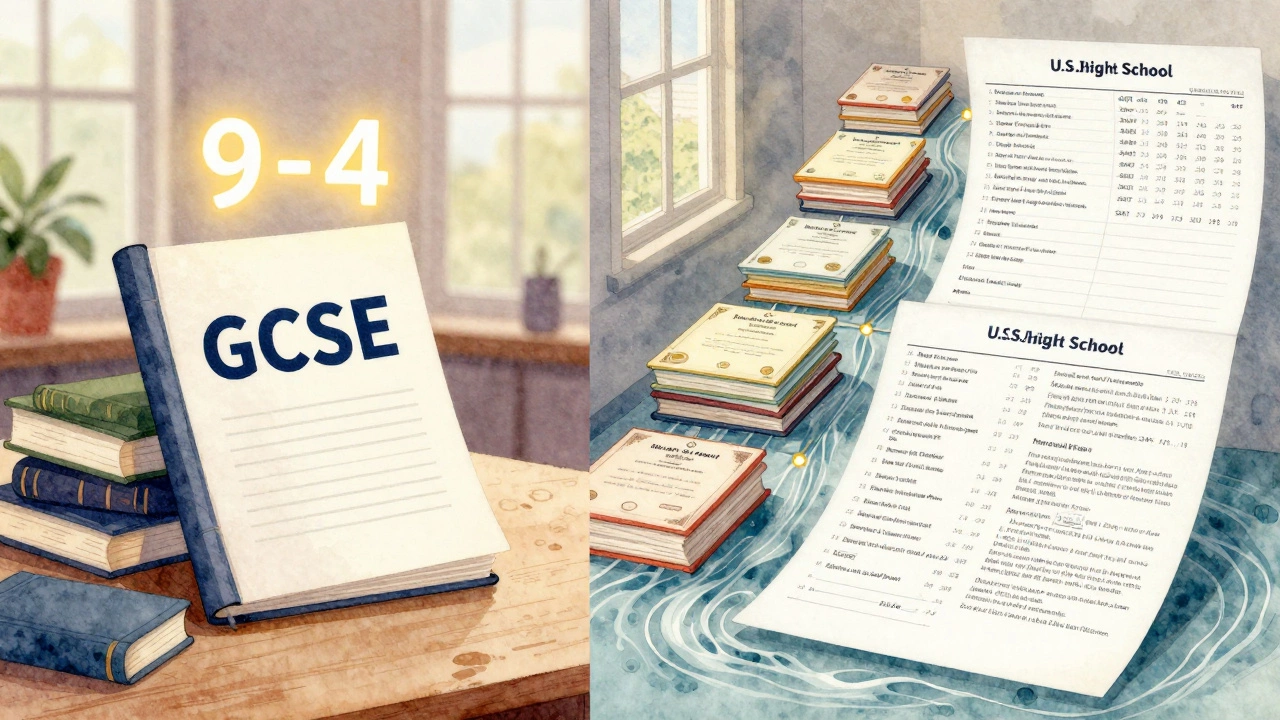
So while GCSEs are like snapshots of your knowledge at 16, U.S. high school performance is a longer film. Your GPA (grade point average) matters more than any single test. A GPA of 3.0-3.5 on a 4.0 scale is similar to passing 5-7 GCSEs at grade 4-6.
What About College Admissions?
When U.S. colleges review international applicants, they don’t just look at GCSEs. They want to see:
- Your GCSE results (especially in core subjects like Math and English)
- Your A-Level or IB scores (if you took them)
- Your SAT or ACT scores
- Letters of recommendation
- Extracurriculars and personal essays
Most U.S. universities treat GCSEs as early indicators of academic ability. They’re important, but not enough on their own. For example, if you got 8 GCSEs at grade 7 or higher, that’s a strong start - but you’ll still need to take the SAT and complete a full U.S.-style high school curriculum to be competitive.
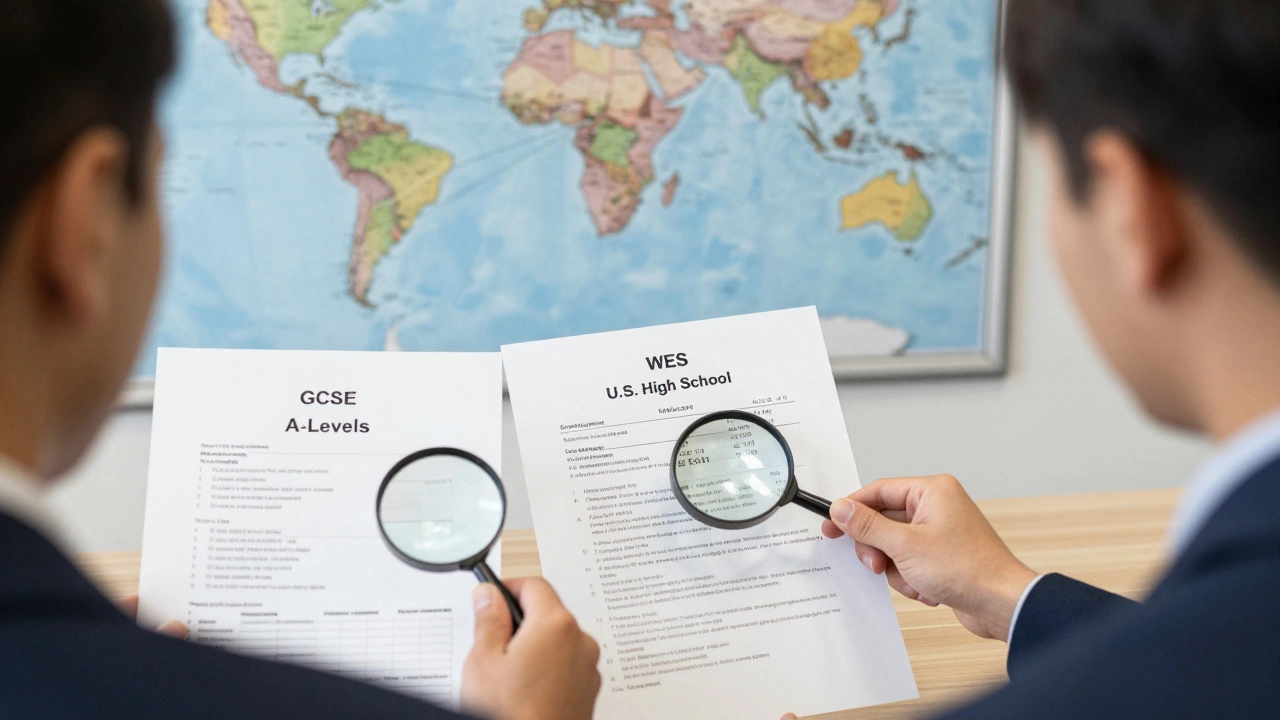
Some schools even require international students to submit a credential evaluation from a company like WES (World Education Services). This converts your GCSEs into U.S. equivalents so admissions officers can compare apples to apples.
What If You’re Moving from the U.S. to the UK?
It works both ways. If a U.S. student moves to England at age 15, they usually enter Year 11 and start preparing for GCSEs. Their previous U.S. credits might count toward some subjects - especially if they’ve already taken Algebra or Biology. But they’ll still need to sit the GCSE exams to get the official qualification.
Similarly, if a student finishes 10th grade in the U.S. (age 15-16), that’s roughly equal to finishing Year 10 in the UK. But they won’t have taken GCSEs yet. They’d need to complete Year 11 to get them.
Why There’s No Perfect Match
The U.S. and UK systems are built differently. The UK focuses on narrow, exam-based assessments at key ages. The U.S. emphasizes continuous assessment, course load, and personal development over four years.
Think of it this way: GCSEs are like finishing a series of standardized tests in middle school - but they count for college admissions. In the U.S., those tests don’t exist. Instead, your entire high school record is the scorecard.
There’s also no U.S. version of the “grade 4 pass” rule. You don’t fail high school because you got a C in Chemistry. You just need to pass all your required courses to graduate. The pressure isn’t on one exam - it’s spread out.
What Should You Do If You’re Planning Ahead?
If you’re a student in the UK thinking of applying to U.S. colleges:
- Take your GCSEs seriously - especially English and Math. These are non-negotiable.
- Plan to take the SAT or ACT in your final year of high school.
- Consider taking Advanced Placement (AP) courses if your school offers them - they’re more familiar to U.S. admissions officers than A-Levels.
- Keep a detailed transcript with grades, subjects, and exam board names.
If you’re a U.S. student heading to the UK:
- Be ready to take GCSEs even if you’ve already studied the subjects.
- Focus on exam technique - U.K. exams are more about written answers than multiple choice.
- Ask your school if they’ll recognize your U.S. credits for any subjects.
Bottom Line
The GCSE equivalent in the U.S. isn’t one thing. It’s the combination of a high school diploma, consistent grades across core subjects, and standardized test scores like the SAT. GCSEs are a snapshot. U.S. colleges look at the whole story.
Don’t try to force a direct comparison. Instead, think of GCSEs as your first major academic checkpoint - and the U.S. system as the next chapter. Both matter. But they’re not the same.
Is a GCSE grade 4 the same as a U.S. high school diploma?
No. A GCSE grade 4 is a passing score in one subject, not a full qualification. The U.S. high school diploma is earned by completing four years of required courses and passing all final exams. One GCSE subject equals one class in the U.S. system - not the whole diploma.
Can I use my GCSEs to get into a U.S. college without taking the SAT?
Very rarely. Most U.S. colleges require either the SAT or ACT from international applicants, even if they have strong GCSE results. Some test-optional schools may accept GCSEs as part of a holistic review, but you’ll still need to provide transcripts, letters, and essays. Don’t assume GCSEs alone are enough.
Do U.S. high schools recognize GCSEs for credit?
Some do, especially private or international schools. If you’ve passed GCSEs in English, Math, or Science, a U.S. school might let you skip introductory courses. But public schools usually require you to take their own versions of those classes. Always check with the school’s guidance counselor.
What’s the closest U.S. test to a GCSE?
There’s no exact match, but state-specific end-of-course exams - like New York’s Regents Exams or California’s CAASPP - are the closest. These are subject-specific, standardized, and taken at the end of a course. However, they’re still not as widely used or as high-stakes as GCSEs across the entire country.
Do U.S. employers care about GCSEs?
Generally, no. U.S. employers focus on your highest completed education - whether that’s a high school diploma, associate’s degree, or bachelor’s degree. GCSEs are only relevant if you’re applying to U.S. colleges or jobs that specifically ask for international credentials. For most jobs, your college degree or work experience matters more.