

Distance vs. Online Learning Selector
Answer these questions to find out which remote study method aligns best with your current situation.
Recommended Path:
Key Considerations for This Mode:
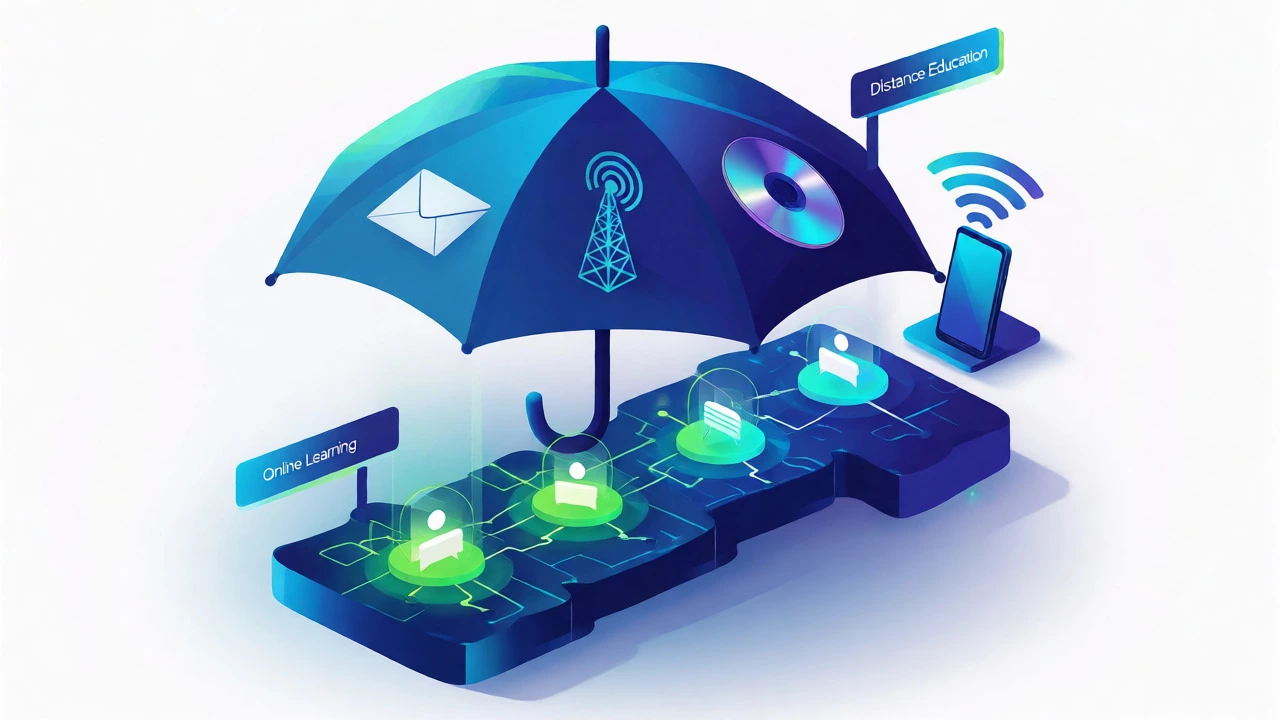
You’ve probably heard people use distance education and online learning interchangeably. It’s a common mix-up. But here’s the twist: they aren’t the same thing. One is a broad umbrella; the other is just one way to lift that umbrella. If you’re trying to pick a study path, confusing them could lead you down the wrong road-like signing up for a high-tech interactive course when you actually needed a quiet, paper-based program.
The Big Picture: What Is Distance Education?
Distance education is any form of learning where the teacher and student are separated by space or time. That’s it. No fancy tech required. Before the internet existed, this was called "correspondence school." You’d get a box of textbooks in the mail, write essays on typewriters, and post them back to your tutor. Today, it still includes those old-school methods, but it also wraps around digital tools.
Think of distance education as the category "vehicles." Cars, bikes, skateboards, and planes all fit under it. They share one trait: they move you from A to B without you walking. Similarly, distance education moves knowledge from teacher to student without physical presence. The key attribute here isn't the technology-it's the separation.
Zooming In: What Is Online Learning?
Online learning, often called e-learning, is a subset of distance education that relies specifically on the internet. It’s the car in our vehicle analogy. It’s fast, modern, and connected. When you log into a Zoom lecture, watch a recorded video on Canvas, or chat with classmates in a Discord server, you’re doing online learning.
But not all distance education is online. Some programs still use CD-ROMs (yes, they exist!), downloadable PDFs sent via email, or even radio broadcasts in remote areas. These are distance education methods that don’t require a live internet connection. This distinction matters if you have spotty Wi-Fi or prefer offline work.
| Feature | Distance Education | Online Learning |
|---|---|---|
| Scope | Broad umbrella term covering all remote study methods. | Specific type using internet-based platforms. |
| Technology | Can be low-tech (mail, radio) or high-tech. | Requires internet access and digital devices. |
| Interaction | May be asynchronous (letters) or synchronous (video). | Often real-time or near-real-time digital interaction. |
| Example | Open University correspondence course. | Coursera or edX interactive module. |
Why Does the Distinction Matter?
You might think, "Who cares? I’m studying from home anyway." But the label affects your experience significantly. Let’s look at three real-world scenarios where this difference hits hard.
1. Internet Dependency: If you choose an online course, you need stable broadband. In rural Australia, where I live, this can be a nightmare. A pure distance education course might allow you to download materials once a week and work offline. An online-only course might require you to be live-streamed during exams. If your connection drops, you fail. Check the technical requirements before enrolling.
2. Accreditation and Recognition: Some employers still view "correspondence" degrees differently than "online" degrees, though this bias is fading. However, regulatory bodies sometimes treat them differently. For instance, certain professional certifications require proctored exams that must be taken in person or via specific secure online browsers. Knowing if your program is purely online or hybrid distance helps you plan for these hurdles.
3. Learning Style Fit: Online learning often pushes for collaboration. Discussion boards, group projects, and peer reviews are standard. If you hate talking to strangers on Slack, you might struggle. Traditional distance education modules are often more solitary. You read, you write, you submit. There’s less social pressure, which some learners find liberating rather than isolating.
Common Types of Distance Education
Since distance education is the broader category, let’s break down its main flavors so you know what you’re looking at.
- Correspondence Courses: The classic model. You receive printed materials or digital files, complete assignments independently, and return them for grading. Interaction with instructors is slow-days or weeks.
- Hybrid (Blended) Learning: This mixes face-to-face classes with remote study. You might attend campus once a month but do everything else online. This is popular for working professionals who want networking benefits without daily commuting.
- Synchronous Online Classes: Live virtual classrooms. Everyone logs in at the same time. Great for structure, bad for flexibility if you travel often.
- Asynchronous Online Modules: You learn at your own pace within set deadlines. Pre-recorded videos, quizzes, and forums. This is the most flexible option for parents or shift workers.

How to Choose the Right Path
Picking between these options isn’t about which is "better." It’s about which fits your life right now. Ask yourself these questions:
- What’s my internet situation? If you’re on mobile data or satellite internet with caps, avoid heavy streaming courses. Look for text-heavy distance programs.
- Do I need human interaction? If you thrive on debate and teamwork, online learning with active forums suits you. If you focus better alone, traditional distance modules might yield better grades.
- How disciplined am I? Online learning requires self-motivation. Without scheduled lectures, procrastination kills many students. Distance education with mailed weekly tasks can provide external accountability.
- What does my employer recognize? If you’re upskilling for a job, check if they accept credits from online platforms like Coursera versus traditional university distance programs. Some industries value the rigor of accredited university distance degrees over micro-credentials.
The Future: Blurring Lines
Technology keeps changing the landscape. With AI tutors and VR classrooms emerging, the line between "online" and "distance" will fade further. Soon, "distance" might just mean "not physically present," while "online" becomes the default delivery method for almost everyone. But for now, understanding the difference saves you from mismatched expectations.
If you’re researching schools, don’t just search for "online degrees." Search for "distance learning providers." You’ll find institutions specializing in remote pedagogy that might offer better support structures than general universities slapping their logo on a web page. Support services-tutoring, library access, mental health resources-are critical in remote study, and specialized distance educators often excel here.
Is online learning always part of distance education?
Yes, in the context of formal education, online learning is typically considered a mode of distance education because the student and instructor are not co-located. However, if you take an online workshop while sitting next to your teacher in a computer lab, that’s not distance education-it’s just digital instruction in a classroom setting.
Are distance education degrees respected by employers?
Generally, yes. Accredited distance education degrees hold the same weight as on-campus degrees. The stigma has largely disappeared, especially since top-tier universities now offer fully online programs. Employers care more about accreditation status and the institution's reputation than whether you studied via Zoom or mail.
Can I switch from online to traditional distance methods mid-course?
It depends on the provider. Some flexible distance education programs allow you to choose your submission format (digital vs. print). However, most structured online courses are designed around digital interactions, so switching to paper-based correspondence mid-way is rare unless the institution explicitly offers hybrid tracks.
What equipment do I need for online learning vs distance education?
For online learning, you need a reliable computer, webcam, microphone, and high-speed internet. For traditional distance education (like correspondence), you primarily need reading materials, writing supplies, and a way to send documents (post or scanner). Basic digital literacy is helpful for both, but the hardware demands are lower for non-online distance methods.
Is distance education cheaper than online learning?
Not necessarily. Costs vary by institution, not just delivery method. Sometimes, highly automated online platforms are cheaper due to scale. Other times, personalized distance tutoring via correspondence costs more due to individualized feedback. Always compare total tuition fees, including hidden costs like software subscriptions or shipping for physical materials.