

IB to A-Level Score Conversion Calculator
University Grade Conversion
This tool helps you understand how IB scores compare to A-Level grades for UK university admissions. Note that while both qualifications are accepted equally, universities set different grade requirements for each system.
Note: The conversion chart below represents approximate equivalencies based on typical university requirements. IB scores are generally more consistent globally while A-Level difficulty varies slightly by exam board.
Russell Group universities typically require 38-42 points for IB or A*AA for A-Levels.
Conversion Results
When it comes to applying to British universities, students from around the world often wonder: does it matter if you take the International Baccalaureate (IB) or A-Levels? The answer isn’t as simple as one being better than the other. But there are clear patterns in how UK universities view these two qualifications - and what they really care about is not the label, but what you’ve learned and how well you’ve done it.
What British universities actually look for
UK universities don’t have a blanket preference for IB over A-Levels or vice versa. They accept both as valid entry routes. In fact, nearly every Russell Group university explicitly states on its admissions page that IB and A-Levels are treated equally. The University of Oxford, for example, says: "We do not have a preference between the IB and A-Levels. We assess applicants on their academic potential and performance in the qualification they have taken." But here’s the catch: while they don’t prefer one over the other, they often expect different things from each. A-Levels are subject-specific. Most students take three or four subjects in depth. If you’re applying for Engineering, you’ll likely have A-Levels in Maths, Physics, and Further Maths. That’s exactly what admissions tutors want to see - focused, high-level mastery in the areas relevant to your course. The IB, on the other hand, is broader. Students take six subjects across different disciplines - sciences, humanities, languages - plus the core elements: Theory of Knowledge, Extended Essay, and Creativity, Activity, Service (CAS). That structure builds well-rounded thinkers. Universities like Cambridge and Imperial College London often praise IB students for their ability to think critically across subjects. So it’s not about preference. It’s about fit.
Grading differences matter
Let’s talk numbers. A-Levels are graded from A* to E. Top universities usually ask for A*AA or AAA. The IB uses a 7-point scale per subject, with a maximum of 45 points total. Top UK universities typically require IB scores between 38 and 42 points, depending on the course. Here’s the key: an IB score of 40 doesn’t mean the same thing as three A*s. Why? Because IB students are graded against a global standard, and the grading is more consistent across countries. A-Levels vary slightly in difficulty between exam boards - Edexcel, AQA, OCR - and some subjects are harder to get top grades in than others. For example, getting an A* in A-Level Physics is statistically harder than getting a 7 in IB Physics. But if you’re applying for a Physics degree, admissions tutors know that. They don’t penalize you for taking a harder subject. In fact, they reward it. A 2023 analysis by UCAS showed that IB students were slightly more likely to receive offers from top universities than A-Level students, but only because IB applicants tend to apply to more competitive courses and have higher predicted grades overall. It’s not that universities prefer IB - it’s that IB students often come with stronger academic profiles.
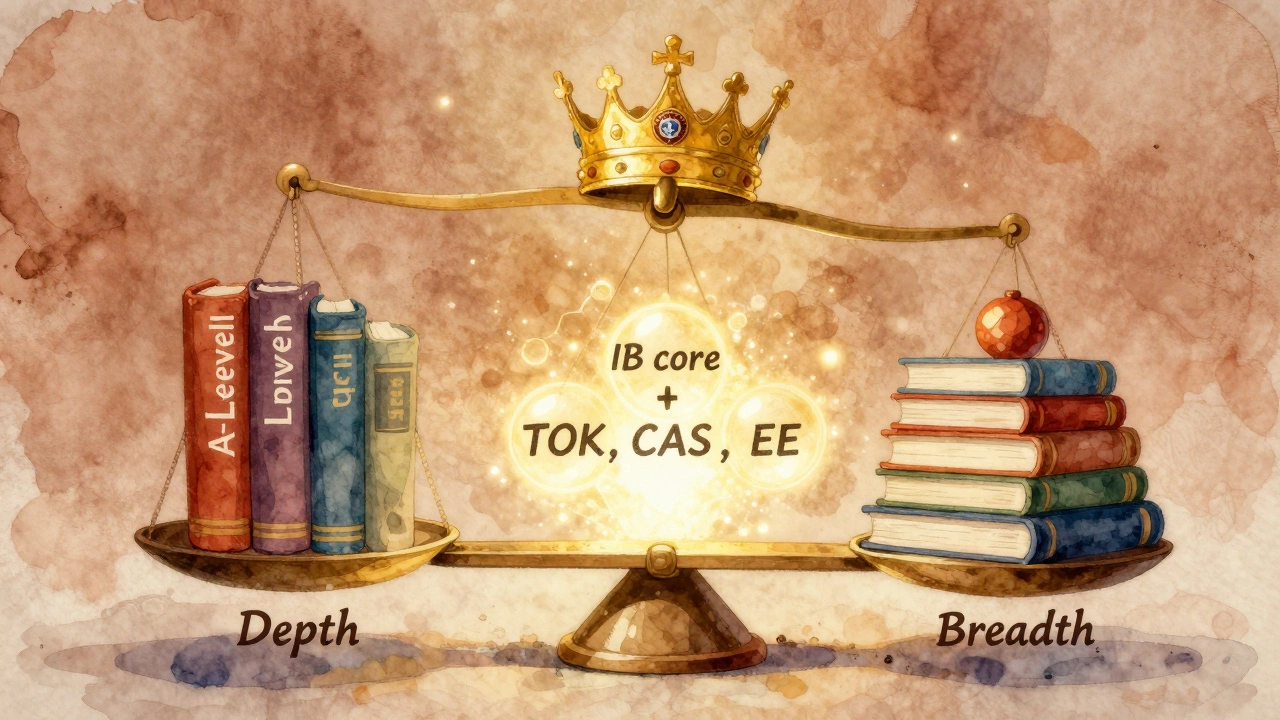
Subject choices: depth vs breadth
If you’re aiming for Medicine, Law, or Engineering, A-Levels give you a clear advantage because you can specialize early. Taking three A-Levels in Biology, Chemistry, and Maths gives you a direct pathway. IB students must also take subjects like History or a foreign language - which might feel like a distraction if you’re laser-focused on science. But if you’re applying for a course like PPE (Philosophy, Politics, and Economics) at Oxford, the IB’s broad structure is a strength. You’ll have taken a science subject, a humanities subject, and a language - exactly the kind of interdisciplinary background these courses look for. Here’s what admissions tutors say: "We don’t care if you took five A-Levels. We care if you took the right three and excelled in them." And for IB students: "We don’t care if you took six subjects. We care if you showed intellectual curiosity across them." The bottom line: choose the system that lets you shine in the subjects that matter most to your chosen degree.
Other factors universities consider
Neither IB nor A-Levels will get you in on their own. Your personal statement, references, interviews, and entrance exams matter just as much - if not more. For example: - If you’re applying to Medicine, you’ll need to score well on the UCAT or BMAT. - If you’re applying to Law, you’ll need to write a strong personal statement showing analytical thinking. - If you’re applying to Engineering at Imperial, you might need to pass an online assessment. IB students often have an edge here because of the Extended Essay. It’s a 4,000-word research paper that demonstrates independent study skills. Many admissions tutors say they value that experience more than a fourth A-Level. Similarly, the IB’s Theory of Knowledge course trains students to question assumptions - a skill that shines in interviews. One tutor at Durham University told us: "IB applicants often come in with more confidence discussing abstract ideas. That’s not because IB is better. It’s because they’ve been taught to think that way." A-Level students aren’t at a disadvantage. Many take part in research projects, internships, or independent reading. What matters is what you’ve done - not what qualification you took to get there.
What the data says
Let’s cut through the noise with real numbers. According to the 2025 UCAS report: - 27% of UK university applicants had A-Levels. - 8% had the IB. - 65% had other qualifications (BTECs, Scottish Highers, etc.). But among applicants accepted to Russell Group universities: - 22% had A-Levels with A*AA or higher. - 11% had IB scores of 38 or above. That means IB students are overrepresented in top university offers compared to their overall application numbers. Why? Because IB students are more likely to apply to highly selective courses and often have stronger predicted grades. It’s also worth noting: international students are far more likely to take the IB. So if you’re applying from outside the UK, you’re probably taking IB - and UK universities are very familiar with it. For UK-based students, A-Levels are still the norm. But universities aren’t biased toward either. They’re looking for excellence, not conformity.

Which one should you choose?
Here’s a simple guide:
- Choose A-Levels if you know exactly what you want to study and want to dive deep into three or four subjects. You’ll have more time to focus, and your grades will directly match your course requirements.
- Choose IB if you’re undecided, love learning across disciplines, or plan to apply to universities outside the UK. The IB’s breadth prepares you for liberal arts degrees and global universities.
- If you’re applying to Medicine, Engineering, or Architecture - A-Levels give you a clearer path. But IB students get in too - if they take the right subjects (e.g., HL Maths, HL Chemistry).
- If you’re applying to PPE, History, Law, or Psychology - IB’s structure can be an advantage. But again, A-Level students with strong essays and critical thinking skills compete just as well.
Final thought: It’s not about the qualification - it’s about the story
Admissions tutors read hundreds of applications. They don’t care whether you did IB or A-Levels. They care whether you’ve shown: - Passion for your subject - Ability to think independently - Consistent academic performance - Curiosity beyond the classroom One student got into UCL with three A-Levels in Biology, Chemistry, and Maths - and spent her summers volunteering at a hospital. Another got into LSE with an IB score of 41 - and wrote a 4,000-word essay on income inequality in post-Brexit Britain. Both were accepted because they told a compelling story. Your qualification is just the starting point.
Do British universities accept IB instead of A-Levels?
Yes, all UK universities accept the IB as an equivalent to A-Levels. They treat both qualifications as valid routes to university admission. Top institutions like Oxford, Cambridge, and Imperial College London have published entry requirements for both systems side by side.
Is it harder to get into university with A-Levels than IB?
No. The difficulty isn’t in the qualification - it’s in the grades. Getting A*AA in A-Levels is just as competitive as scoring 40+ in the IB. Universities set different grade requirements for each, so they’re calibrated to be equally challenging. What matters is meeting the standard for your chosen course.
Do I need to take four A-Levels to stand out?
No. Most universities only require three A-Levels. Taking a fourth doesn’t improve your chances unless you’re applying to extremely competitive courses like Medicine at Oxford, where some applicants take four. But even then, three A*s are more valuable than four A’s.
Can I switch from IB to A-Levels halfway through?
It’s possible but not recommended. Most schools don’t allow mid-course switches because the IB and A-Level curricula are structured differently. If you’re struggling, talk to your school about support options. Switching systems late can hurt your grades more than help them.
Do UK universities prefer higher-level (HL) IB subjects?
Yes, for course-specific subjects. If you’re applying for Engineering, having HL Maths and HL Physics is essential. For most courses, universities will specify which HL subjects they expect. HL subjects carry more weight than SL because they represent deeper knowledge.