
GCSE English Grade Estimator
0%
0 out of 0 marks
Interpretation:
Enter your marks to see analysis.
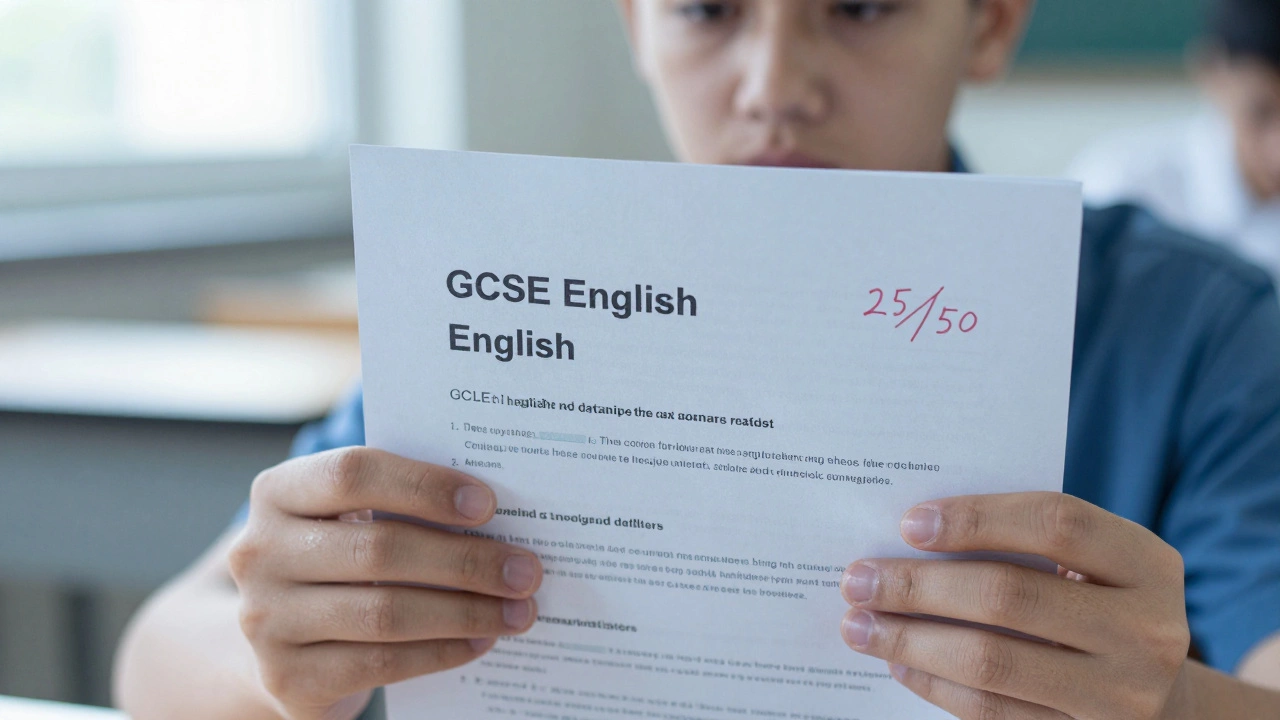
Imagine you’ve just finished your GCSE English is a core academic qualification in England, Wales, and Northern Ireland that assesses literacy and communication skills. exam. You check your answers against the marking scheme at home. You count up your marks: 25 out of 50. That’s exactly 50%. Your heart sinks. You think, "I failed." But here is the shocker: you might have actually passed with a solid grade.
The short answer to "Is 50% a pass in GCSE English?" is no, not in the way most people think. In fact, scoring exactly 50% of the total available marks usually lands you right on the border between a Grade 4 (Standard Pass) and a Grade 3 (Weak Pass). Depending on the specific exam board and the difficulty of that year's paper, 50% could even be a Grade 5 (Strong Pass).
This confusion happens because GCSEs don't work like school quizzes where 50% is the magic number for passing. They use a complex system called Unmoderated Criterion-Referenced Assessment (UCEA) is the standard framework used by UK awarding bodies to set grade boundaries based on student performance and question difficulty.. Let’s break down how this works so you stop guessing and start understanding what those numbers really mean.
Why Percentage Marks Are Misleading
We are taught from a young age that 50% is half the work, so it should be half the grade. But GCSEs are designed differently. The goal isn't to see if you got half the questions right. The goal is to measure if you meet a specific standard of competency defined by the government and exam boards.
Think of it like driving. If you take a driving test, you don't pass because you did 50% of the maneuvers correctly. You pass because you demonstrated safe control of the vehicle within a set of criteria. GCSEs are similar. The "pass" mark changes every single year based on how hard the exam was.
If the exam was particularly difficult, the boundary for a Grade 4 might drop to 45%. If the exam was easier, the boundary might rise to 55%. This means two students getting 50% raw marks in different years could end up with different grades. One passes, one fails. This variability is why looking at percentages alone is dangerous.
Decoding the 9-1 Grading Scale
To understand where 50% fits, we first need to look at the current grading scale. Since 2017, GCSEs have been graded from 9 to 1, replacing the old A*-G system. Here is what matters for your result:
- Grade 9-7: High achievement (equivalent to old A/A-)
- Grade 6-5: Strong pass (equivalent to old B)
- Grade 4: Standard pass (equivalent to old C). This is often considered the "real" pass for many schools and employers.
- Grade 3: Weak pass (equivalent to low C/high D). Some institutions accept this, but many do not.
- Grade 2-1: Fail (equivalent to E-G)
- U: Ungraded (below level 1)
When people ask if they passed, they usually mean: "Did I get a Grade 4 or above?" This is the threshold required for most sixth forms and apprenticeships. So, does 50% raw marks equal a Grade 4?
In most recent exams from major boards like AQA, Edexcel, and OCR, a Grade 4 typically requires between 45% and 52% of the total marks. A Grade 5 usually sits between 55% and 60%. So, yes, 50% is very much in the danger zone of a pass. It is rarely a fail, but it is also rarely a strong pass.
How Exam Boards Set the Boundaries
You might wonder who decides these numbers. It’s not random. Each exam board (like AQA is one of the largest non-profit exam boards in the UK, administering GCSEs to millions of students.) uses a process called moderation. After the exams are marked, statisticians analyze the performance of thousands of students.
They look at "anchor questions"-questions that are expected to remain stable in difficulty year over year. If students generally score lower on these anchor questions than last year, the board assumes the whole paper was harder. They then adjust the grade boundaries downward to compensate. This ensures that a Grade 4 in 2026 represents the same level of skill as a Grade 4 in 2025.
This system protects you. If you had a bad day or the questions were tricky, the boundaries shift to help you stay in the same grade band. Conversely, if the paper was easy, the bar gets raised so grades aren't inflated.
| Grade | Description | Approximate % of Total Marks |
|---|---|---|
| 9 | Exceptional | 85% - 90%+ |
| 7 | High | 70% - 75% |
| 5 | Strong Pass | 55% - 60% |
| 4 | Standard Pass | 45% - 52% |
| 3 | Weak Pass | 35% - 44% |
| 1 | Fail | Below 35% |
Note that these percentages are estimates. The exact boundary for a Grade 4 can vary by a few percentage points depending on whether you took English Language or English Literature, and which board you sat with.
English Language vs. English Literature
It is crucial to distinguish between GCSE English Language is an exam focusing on writing skills, reading comprehension, and analysis of non-fiction texts. and GCSE English Literature is an exam focusing on the analysis of novels, plays, and poetry from the canon.. Most students take both, but the grading dynamics can differ slightly.
English Language is more subjective. Essays and creative writing pieces are marked using levels rather than simple tick-box answers. This means small differences in examiner interpretation can shift your final mark. A 50% score in English Language might feel lower because the writing component carries heavy weight, but the leveling system often rewards structure and clarity over perfect vocabulary.
English Literature has more fixed answers. You either know the quote or you don’t. However, the analysis still requires depth. Historically, Literature grade boundaries tend to be slightly higher than Language because there is less room for "partial credit" in factual recall. If you scored 50% in Literature, you are likely closer to a Grade 4 than if you scored 50% in Language, where the curve might push you higher.
What Counts as a "Pass"?
Here is where it gets tricky. Legally, a Grade 1 is a "pass" because you received a certificate. But socially and professionally, a Grade 1 is treated as a fail. The real debate is between Grade 3 and Grade 4.
In 2026, the UK government continues to push for Grade 4 as the benchmark. Many state-funded secondary schools report their success rates based on the percentage of students achieving a Grade 4 or above in English and Maths. Universities and apprenticeship programs increasingly require a Grade 4.
If you get a Grade 3, you have technically passed the exam, but you may find doors closing. You might need to retake the exam in Year 12 or complete a functional skills course alongside your other studies. So, when asking if 50% is a pass, you are really asking: "Is 50% enough for a Grade 4?" And as we saw, the answer is usually yes, but barely.

Retakes and Functional Skills
If you suspect you are hovering around that 45-50% range, you have options. In England, students who do not achieve a Grade 4 in English (or Maths) are often required to retake the subject until they do. This can happen in Year 12 or even into adulthood.
Alternatively, you can pursue Functional Skills English is a vocational qualification focused on practical literacy skills for daily life and work, recognized by many colleges and employers.. This is not a GCSE, but it is widely accepted as proof of basic competence. For many careers, a Level 2 Functional Skills certificate is sufficient if you lack a Grade 4 GCSE.
If you are worried about your results, don't panic over the 50% figure. Focus on what you can control now: reviewing past papers, understanding the mark schemes, and practicing timed writing. Knowing that 50% is likely a pass gives you confidence, but aiming for 60% secures your future.
Common Mistakes That Cost You Those Extra Marks
Why do so many students hover around 50%? Usually, it’s not because they don’t know the material. It’s because they lose marks on technicalities. Here are three common pitfalls:
- Ignoring the Command Words: Questions ask you to "analyze," "compare," or "evaluate." If you only describe what happened, you miss the higher-level marks. Description gets you to 50%; analysis gets you to 70%.
- Poor Time Management: Running out of time on the writing section means leaving paragraphs unfinished. An incomplete argument scores lower than a shorter, complete one.
- Lack of Structure: Examiners scan for PEEL paragraphs (Point, Evidence, Explanation, Link). Without this structure, your ideas get lost, and you lose marks for coherence.
Fixing these issues can easily boost your score from 50% to 60%, moving you from a shaky Grade 4 to a secure Grade 5.
Does 50% guarantee a pass in GCSE English?
No, 50% does not guarantee a pass in the sense of a Grade 4. While it is often close to the boundary, the exact grade depends on the exam board and the difficulty of the paper. In some years, 50% might result in a Grade 3, which is considered a weak pass or fail by many institutions.
What is the difference between a Grade 3 and a Grade 4?
A Grade 4 is a "standard pass" equivalent to an old C grade. It is the minimum requirement for most sixth forms and apprenticeships. A Grade 3 is a "weak pass" equivalent to a low C or high D. Many schools and employers view a Grade 3 as insufficient, requiring retakes or additional qualifications.
Do all exam boards use the same grade boundaries?
No, each exam board (such as AQA, Edexcel, and OCR) sets its own grade boundaries. While they aim for consistency across the country, the exact percentage needed for a Grade 4 can vary slightly between boards and between English Language and English Literature papers.
Can I retake my GCSE English if I get a Grade 3?
Yes, in England, students who do not achieve a Grade 4 in English are often required to retake the exam in Year 12. Alternatively, you can study for Functional Skills English, which is accepted by many colleges and employers as an alternative to a GCSE Grade 4.
How are GCSE grade boundaries calculated?
Grade boundaries are calculated using a statistical process called moderation. Exam boards analyze student performance on "anchor questions" to determine the overall difficulty of the paper. If the paper was harder than usual, boundaries are lowered to ensure fairness across different years.