

GCSE Grade Checker
Check Your GCSE Result
Select your GCSE grade to see if it's a pass, fail, or borderline.
When you see a grade 3 on your GCSE results, your first thought might be: Did I fail? The short answer? No, a 3 isn’t a fail - but it’s not a pass either. And that gray area is what trips up so many students, parents, and even teachers.
What does a grade 3 actually mean?
The GCSE grading system changed in 2017. Before that, grades went from A* to G. Now, they’re numbered from 9 to 1, with 9 being the highest. A grade 4 is the official standard pass. A grade 5 is a strong pass. That’s what most colleges and employers look for.
A grade 3 sits right between those two. It’s below the standard pass, but it’s still a recognized achievement. It’s not an U (ungraded), which is the real fail. A grade 3 means you showed some understanding - you got part of the content, answered some questions correctly, and didn’t leave everything blank. It’s not nothing. But it’s not enough to meet the minimum bar for most next steps.
Why does this confusion exist?
Many people still think of GCSEs the old way. They remember that a D was a pass, and a G was a fail. So when they see a 3, they assume it’s like a G - a failure. But that’s outdated thinking. The system was redesigned to be clearer: 4 and above = pass, 3 and below = below pass. But the language didn’t catch up.
Schools often say, “You need a 4 or higher to pass.” That’s technically true. But when a student gets a 3, they hear: “You failed.” And that’s where the emotional damage starts. A 3 isn’t a reflection of your intelligence. It’s a reflection of one exam on one day. Many students who got a 3 in English or Maths went on to retake, improve, and thrive.
What happens if you get a 3 in English or Maths?
These two subjects are special. If you’re under 18 and got a 3 in either English Language or Maths, you’re legally required to continue studying them until you hit a grade 4 or higher. This isn’t a punishment - it’s support. The government recognizes that these skills are essential for work, further education, and daily life.
You’ll likely be enrolled in a resit course. Most colleges and sixth forms offer free retake classes. You’ll get extra support, smaller groups, and more time to prepare. Many students who struggled the first time around pass on their second attempt. In fact, over 60% of students who retake English or Maths at 16-18 end up getting a grade 4 or higher.
What about other subjects?
If you got a 3 in History, Art, or Biology? No legal requirement to retake. But here’s the catch: most sixth forms, colleges, and apprenticeships require at least a grade 4 in core subjects - even if you’re applying for a creative or technical course.
For example, if you want to do A-Levels in Psychology but got a 3 in Maths, many schools will still ask you to retake it. Why? Because the course involves data analysis. They don’t want you to struggle later.
Some colleges will accept you with a 3 if you have strong grades elsewhere - especially in vocational subjects. But you’ll need to talk to them directly. Don’t assume. Ask.

Is a 3 the end of the road?
No. Not even close.
One student I worked with got a 3 in English Language. She cried for two days. She thought she’d never get into university. But she signed up for a night class, studied with a tutor twice a week, and retook the exam at 17. She got a 5. Two years later, she graduated with a degree in journalism.
Another got a 3 in Maths. He went into a construction apprenticeship. His employer paid for him to retake the exam. He passed on his second try. Now he runs his own small building firm.
A grade 3 doesn’t define you. It’s a checkpoint, not a dead end.
What should you do next?
If you got a 3, here’s what to do - in order:
- Don’t panic. This isn’t a life sentence.
- Check your results sheet. Did you get a 3 in English or Maths? If yes, you’ll automatically be contacted by your school or college about retake options.
- Ask your teacher. What parts of the exam did you miss? Was it exam technique? Topic gaps? Time pressure? Knowing this helps you fix it.
- Find your retake route. Most schools offer retakes in November. If not, local colleges usually do. Some even offer online prep.
- Use free resources. Websites like BBC Bitesize, Corbettmaths, and Seneca Learning have targeted revision for grade 3 students. They break down exactly what you need to improve.
What’s the difference between a 3 and a U?
This is critical. A U (ungraded) means you scored so low that the exam board couldn’t assign a number. You might have left most of the paper blank, didn’t attempt key questions, or didn’t meet even the lowest standard.
A 3? You tried. You wrote answers. You showed some knowledge. You’re not alone. Over 18% of students in England got a 3 in English Language in 2024. That’s more than 1 in 5. You’re in good company.
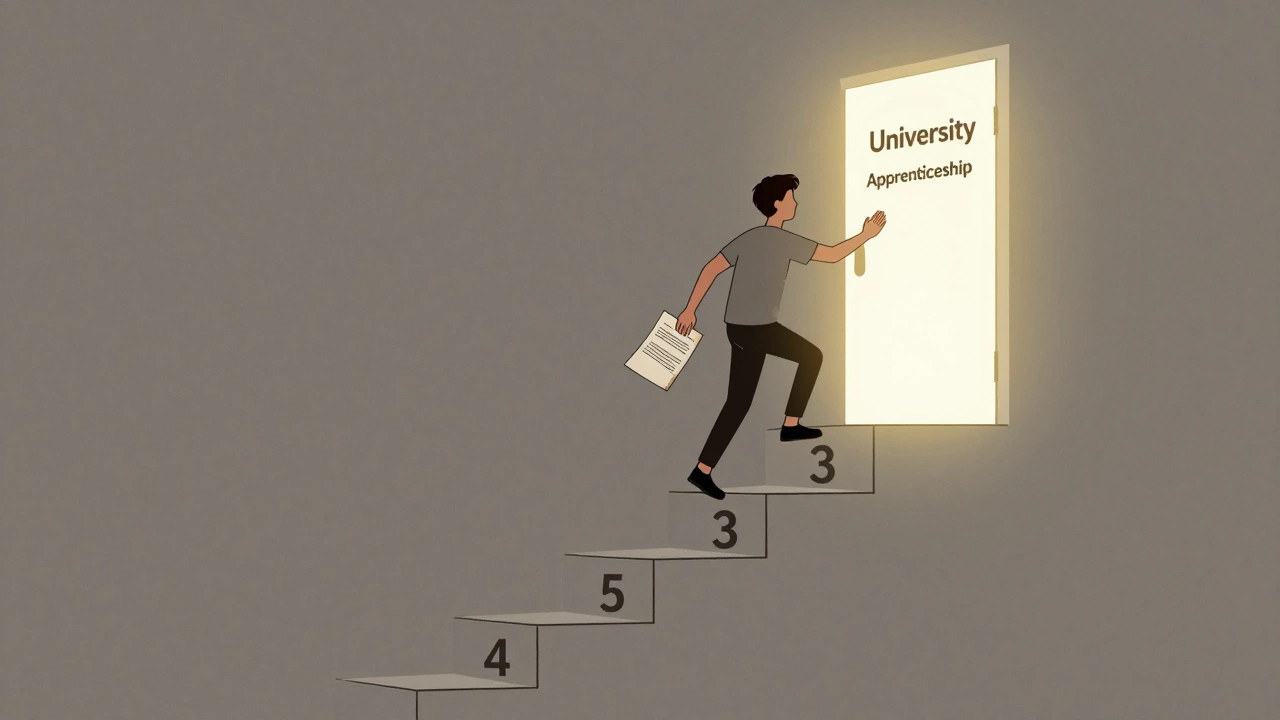
Can you still go to university with a 3?
Yes - but not directly. You can’t enter university with a 3 in English or Maths. You’ll need to retake and pass first. But many students do this while doing a Level 3 course (like BTECs or A-Levels) and then move on.
Some universities accept students with a 3 if they have strong alternatives - like a Level 3 diploma in a related field. But again, you’ll need to talk to admissions teams. Don’t assume you’re locked out.
How do you turn a 3 into a 4?
It’s easier than you think. Most students who retake improve because they know what to expect. The first time, you’re guessing. The second time, you’ve seen the format, the question styles, the common traps.
Focus on these three things:
- Exam technique: Learn how to structure answers. For English, practice writing full paragraphs with evidence. For Maths, show your working - even if you get the final answer wrong, you can still earn method marks.
- Target weak areas: Use your results breakdown. If you lost marks on poetry analysis, drill that. If you struggled with fractions, relearn them. Don’t just re-read notes - do practice questions.
- Practice under timed conditions: Sit past papers with a stopwatch. You’ll find out if time is your enemy.
Final thought: It’s not about the grade. It’s about the next step.
A grade 3 isn’t a failure. It’s a signal. It’s telling you: “You’re close. You just need one more push.”
Thousands of people have turned a 3 into a 4, then a 5, then a degree, then a career. It doesn’t happen overnight. But it happens - every day.
Don’t let a number decide your future. Let your next action.
Is a GCSE grade 3 a fail?
No, a grade 3 is not a fail. It’s below the standard pass (grade 4), but it’s still a graded result. A true fail is a U (ungraded), which means almost no work was completed. A grade 3 shows you understood some of the material - you just didn’t reach the minimum pass threshold.
Do I have to retake GCSEs if I get a 3?
You’re legally required to retake English Language and Maths if you’re under 18 and got a grade 3. For other subjects, retaking is optional. But most colleges and employers expect a grade 4 or higher, so retaking is strongly advised - even if it’s not mandatory.
Can I go to university with a GCSE grade 3?
Not directly. Most universities require at least a grade 4 in English and Maths. But you can still get into university if you retake and pass those subjects while studying a Level 3 course like A-Levels or a BTEC. Many students do this successfully.
How hard is it to go from a 3 to a 4 in GCSE?
It’s much easier than most people think. Around 60% of students who retake English or Maths after getting a 3 pass on their second attempt. The key is focusing on exam technique and past papers - not just relearning content. You’ve already seen the exam format. That gives you a huge advantage.
Are there free resources to help me retake GCSEs?
Yes. BBC Bitesize, Corbettmaths, Seneca Learning, and the exam board websites (AQA, Edexcel, OCR) offer free revision materials specifically designed for students retaking GCSEs. Many local colleges also offer free evening or weekend classes. Your school may still be able to help you access these too.