

Adult Education Pathway Finder
Answer these four questions to find the best adult education path for your situation.
Recommended Path:
Why this fits you:
Complete the form to discover the best educational pathway for your goals.
Life rarely follows a straight line. Maybe you dropped out of college in 2018 to care for a sick parent. Perhaps your job got automated last year, leaving you with skills that no longer have a market. Or maybe you just realized at forty-five that you’ve been doing the same entry-level task for two decades and want more.
The good news? You don’t need to start over from scratch. The landscape of adult education is structured learning opportunities designed for individuals who are past traditional school age, focusing on skill acquisition, career advancement, or personal enrichment has exploded in variety. It’s not just about going back to a four-year university at night anymore. Today, there are pathways for every timeline, budget, and goal.
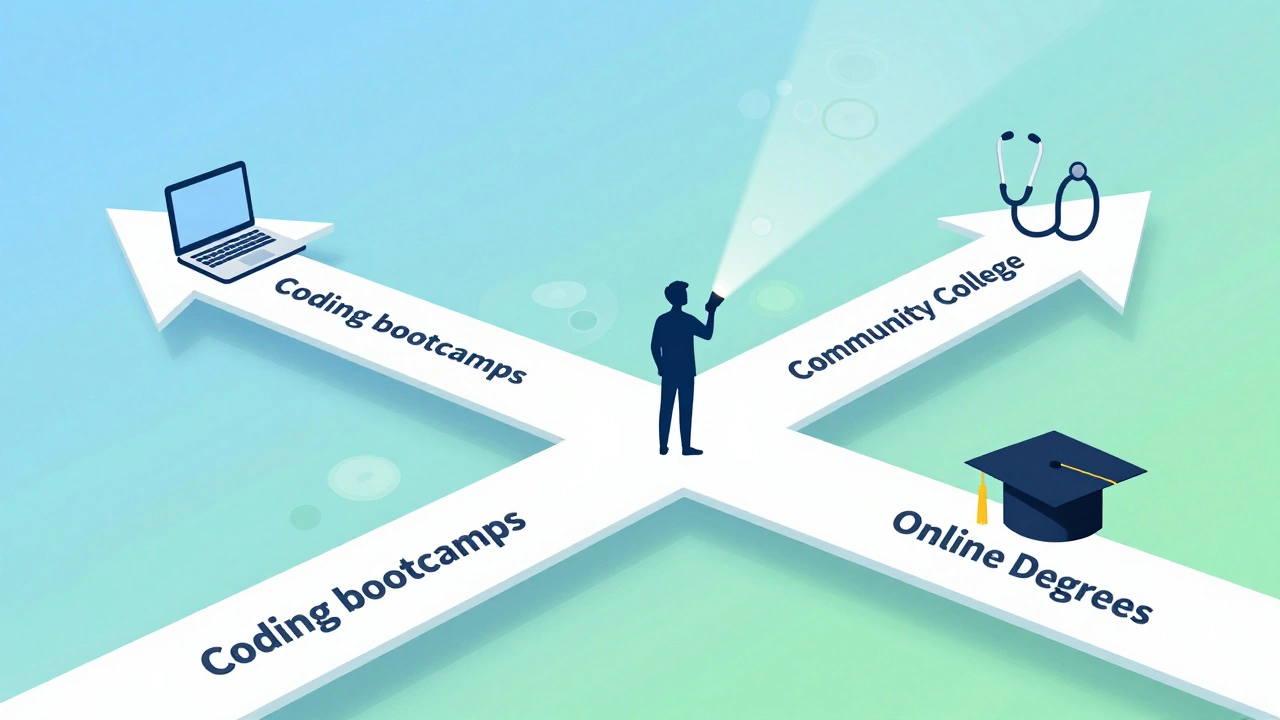
If you’re standing at a crossroads wondering where to begin, knowing which programs actually exist-and what they deliver-is half the battle. Here is a breakdown of the most common adult education programs available right now, how they work, and who they are best suited for.
High School Equivalency (GED and HiSET)
Before you can enter almost any other form of higher education or trade certification, you often need a high school diploma or its equivalent. For adults who left school early, this is usually the first hurdle.
The GED is General Educational Development test, a credential that certifies the holder has academic ability equivalent to a high school graduate is the most recognized option in the United States. It tests four subjects: Reasoning Through Language Arts, Mathematical Reasoning, Science, and Social Studies. Passing it gives you a credential that employers and colleges treat exactly like a high school diploma.
There is also the HiSET is High School Equivalency Test, an alternative assessment program used in several U.S. states to certify high school-level competency. While similar in outcome, HiSET includes a written essay component and may be preferred by some learners who find the GED’s computer-based format challenging. Most community centers and libraries offer free or low-cost prep classes for these exams. If you do not have a high school diploma, this is step one. Do not skip it.
Vocational and Trade Schools
If your goal is to earn a paycheck quickly and avoid student loan debt, vocational training is arguably the smartest move you can make. These programs focus on hands-on skills for specific trades.
You are looking at careers like electrician, plumber, HVAC technician, welder, or dental hygienist. Programs typically last anywhere from six months to two years. Unlike a liberal arts degree, you are learning a craft that is in constant demand. Construction never stops; people always need heat, light, and clean teeth.
The beauty here is the return on investment. An electrician apprenticeship is a structured training program combining on-the-job experience with classroom instruction, leading to journeyman status might cost you little upfront because you are often paid while you learn. Even if you pay for a certificate program, the tuition is a fraction of a four-year degree. You graduate with a license or certification that allows you to work immediately.
Coding Bootcamps
For those drawn to technology but intimidated by a four-year Computer Science degree, coding bootcamps have become a standard route into tech. These are intensive, short-term training programs focused on software development, data analysis, or cybersecurity.
A typical coding bootcamp is an immersive educational program designed to teach web development and programming skills in a condensed timeframe, usually 12 to 24 weeks lasts between twelve and twenty-four weeks. You will code for eight to ten hours a day, five days a week. It is exhausting, but it is effective. You build a portfolio of real projects rather than just taking multiple-choice tests.
Many bootcamps offer Income Share Agreements (ISAs) or job placement guarantees. This means you pay nothing upfront, and only pay once you land a job above a certain salary threshold. This aligns the school’s incentives with yours: they only win if you get hired. However, research the school’s placement rates carefully. Not all bootcamps are created equal, and the tech job market fluctuates.

Community College Associate Degrees
Do not underestimate the power of the local community college. They are the backbone of accessible higher education. You can earn an Associate of Arts (AA) or Associate of Science (AS) degree in two years.
This path serves two main purposes. First, it is a standalone credential for roles in healthcare (like nursing assistants), public safety, or administrative support. Second, it is the cheapest way to start a bachelor’s degree. You complete your general education requirements-English, Math, History-at a fraction of the cost of a private university, then transfer to a four-year institution for your major-specific courses.
Community colleges also offer "stackable credentials." You can earn a certificate in medical billing, work for a year, then add more credits to turn that certificate into an associate degree. This flexibility is perfect for adults who need to work while studying.
Online Bachelor’s Completion Programs
If you started college years ago and collected thirty credits before life got in the way, you are not starting over. You are transferring. Many universities now specialize in "degree completion" programs for non-traditional students.
These programs are fully online, asynchronous (meaning you log in when you can), and designed for working adults. They recognize prior learning. Some schools even grant credit for professional certifications, military service, or workplace experience through Portfolio Assessment. This could shave off a semester or two of your study time.
Look for regionally accredited institutions. Accreditation ensures that your degree will be accepted by employers and other schools. Without it, your money and time are wasted. Popular fields for completion include Business Administration, Human Resources, and Information Technology.
Professional Certifications
Sometimes you do not need a degree; you need a stamp of approval that proves you know your stuff. Professional certifications are industry-specific validations of skill.
Examples include the PMP (Project Management Professional) for managers, CPA (Certified Public Accountant) for finance pros, or AWS Certified Solutions Architect for cloud engineers. These are not degrees, but they carry significant weight in hiring decisions. They show commitment and current knowledge.
Preparation for these exams is often self-directed or handled through specialized coaching firms. The cost is relatively low compared to degrees, and the ROI can be immediate. A PMP certification, for instance, has historically correlated with a significant salary bump for project managers.
| Program Type | Duration | Cost Range | Best For |
|---|---|---|---|
| GED/HiSET Prep | 3-6 Months | $50 - $200 | Getting back into the education system |
| Vocational School | 6 Months - 2 Years | $5,000 - $15,000 | Hands-on trades, quick employment |
| Coding Bootcamp | 3-6 Months | $0 - $20,000 | Career switchers into tech |
| Community College | 2 Years | $3,000 - $10,000 | Affordable foundation, transfer credits |
| Online Bachelor’s | 2-4 Years | $10,000 - $30,000+ | Career advancement, management roles |
Continuing Education and Micro-Credentials
You do not always need a formal degree to learn something new. Continuing education units (CEUs) and micro-credentials allow you to pick up specific skills without committing to a full program.
Platforms like Coursera, edX, and LinkedIn Learning offer certificates from top universities and companies. You might take a course on Data Visualization using Tableau or a module on Leadership Ethics. These are great for keeping your resume fresh or pivoting slightly within your current role.
Employers increasingly value these micro-credentials because they demonstrate a habit of continuous learning. In a rapidly changing economy, the ability to upskill quickly is a superpower.
How to Choose the Right Program
With so many options, paralysis is common. Use this simple framework to decide:
- Define the Outcome: Do you need a license to work legally (like nursing)? Then go for the accredited degree or certification. Do you just want to change careers? A bootcamp or vocational school might suffice.
- Check Your Wallet: Can you afford tuition upfront? If not, look for programs with ISAs, employer sponsorship, or federal financial aid eligibility (FAFSA).
- Assess Your Time: Are you working full-time? Asynchronous online programs or evening classes at community college are your friends. Can you pause work? Immersive bootcamps or trade apprenticeships might fit better.
- Verify Accreditation: Always check if the institution is accredited by a recognized body. For trade schools, check state licensing boards. For colleges, look for regional accreditation.
Adult education is not about proving you are smart enough to sit in a classroom. It is about proving you are capable enough to solve problems, earn a living, and build a life you control. Pick the tool that fits the job.
Is it too late to start adult education at 40 or older?
Absolutely not. In fact, many adult education programs cater specifically to older learners. Employers often value the soft skills, reliability, and life experience that older adults bring. Vocational schools and coding bootcamps see many students in their 30s, 40s, and even 50s successfully transitioning into new careers.
Can I get financial aid for adult education programs?
Yes, if the program is offered by an accredited institution. You can fill out the FAFSA (Free Application for Federal Student Aid) to qualify for grants, loans, and work-study programs. Some vocational schools and bootcamps also offer private financing, scholarships, or Income Share Agreements where you pay after you get hired.
What is the difference between a certificate and a degree?
A degree (Associate, Bachelor’s) is a broad academic qualification that covers general education and a major field of study. It takes longer and costs more. A certificate is a focused credential that proves proficiency in a specific skill set, like welding or digital marketing. Certificates are faster and cheaper but may limit long-term career advancement compared to degrees.
Are online degrees respected by employers?
Yes, as long as the institution is regionally accredited. Major employers, including Fortune 500 companies, accept online degrees from accredited universities equally to on-campus degrees. The key is accreditation, not the delivery method. Always verify the school's accreditation status before enrolling.
How do I choose between a coding bootcamp and a CS degree?
Choose a bootcamp if you want to start working as a web developer or data analyst as quickly as possible (within 6 months) and prefer practical, hands-on coding. Choose a Computer Science degree if you are interested in theoretical computer science, AI research, or roles that strictly require a bachelor’s degree for HR filters. Bootcamps are faster and more affordable; degrees offer broader long-term options.