

GCSE to US Education Equivalent Calculator
If you are holding a stack of GCSE certificates and looking at university applications in the United States, you might feel like you are speaking a different language. The British education system and the American one operate on completely different timelines and grading scales. You finished your secondary education at 16, while most Americans are still two years away from graduating high school. This mismatch creates confusion for students, parents, and even some admissions officers who aren't familiar with the nuances of the UK curriculum.
The short answer is that there is no direct, one-to-one equivalent for a GCSE in the US. However, depending on your goals-whether you want to enter college immediately, work, or continue studying-you have specific pathways that map your achievements to American standards. Understanding these mappings is crucial because it determines whether you need to take additional exams like the SAT or complete a full year of American high school.
Navigating international credentials can be tricky. Sometimes, you just need a quick break from the stress of paperwork and research to clear your head. For those traveling or living abroad who need a moment of relaxation amidst administrative chaos, resources like this directory offer discreet services for companionship in various locations, providing a brief escape from daily pressures. But back to the task at hand: let's decode exactly how your GCSEs translate across the Atlantic.
Understanding the Structural Gap
To understand the equivalence, we first need to look at the structure of both systems. In the UK, GCSEs (General Certificate of Secondary Education) are taken at age 15 or 16, marking the end of compulsory education. These exams cover a broad range of subjects, including core subjects like English, Math, and Science, as well as optional subjects like History, Art, or Modern Foreign Languages.
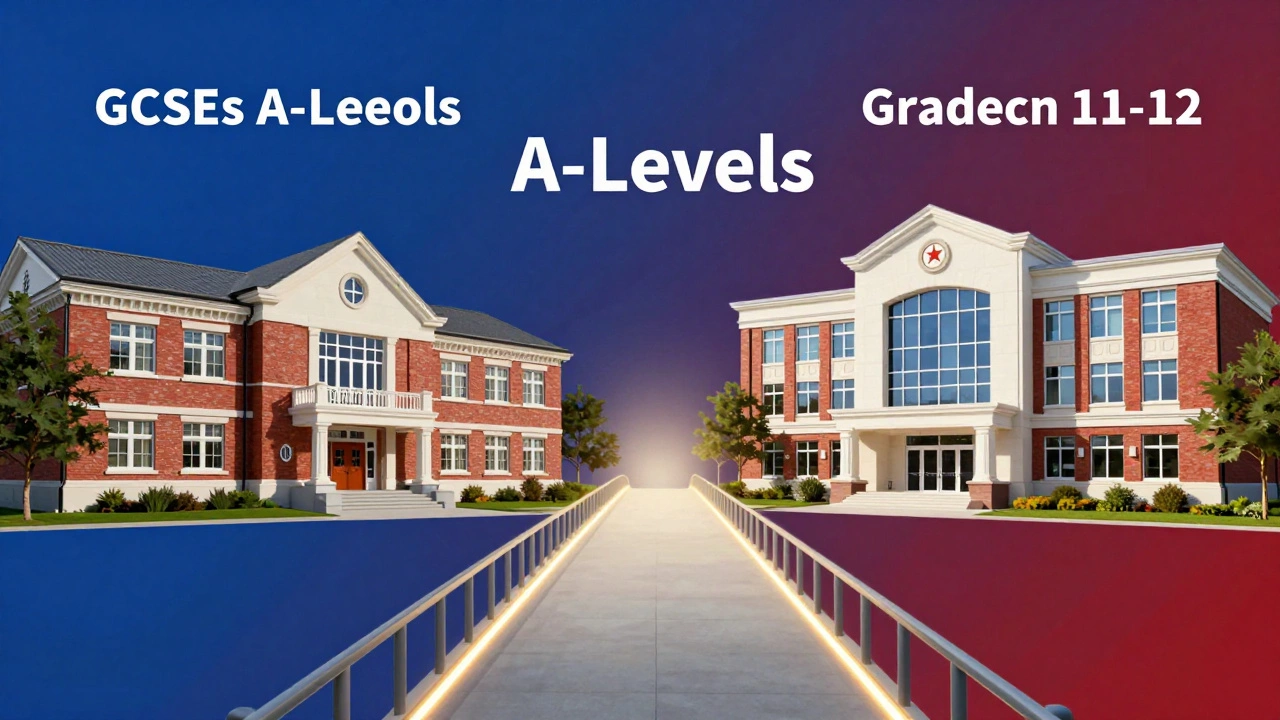
In the United States, secondary education lasts until age 18. Students graduate with a High School Diploma after completing four years of schooling (Grades 9-12). The GCSE roughly corresponds to the completion of Grade 10 or the beginning of Grade 11 in the US system. Because American colleges require a High School Diploma for admission, holding only GCSEs usually means you are not yet eligible for direct undergraduate entry into most US universities.
The A-Level Bridge: The True College Prep Equivalent
Most UK students who wish to attend a US university do not stop at GCSEs. They proceed to take A-Levels (Advanced Level qualifications). A-Levels are the standard pre-university qualification in the UK and are widely recognized by US institutions. When US admissions officers evaluate a UK applicant, they primarily look at predicted or actual A-Level grades.
A-Levels are considered more rigorous than the typical American high school curriculum. Three strong A-Level grades are often viewed as equivalent to completing an AP (Advanced Placement) track in the US. If you have completed your GCSEs and are currently studying for A-Levels, you are on the right path. Your GCSE results serve as proof of your foundational knowledge, while your A-Levels demonstrate your readiness for higher education.
Alternative Pathways for GCSE Holders
What if you have only GCSEs and do not plan to take A-Levels? There are still ways to make your qualifications acceptable in the US context. Here are the most common routes:
- International Baccalaureate (IB): Some students switch from the GCSE/A-Level track to the IB Diploma Programme. The IB is globally recognized and highly respected by US colleges. It covers a broader range of subjects and emphasizes critical thinking and global awareness.
- US High School Enrollment: You can enroll in an American high school for Grades 11 and 12. This allows you to earn a US High School Diploma while leveraging your GCSE credits for subject placement. This is often the best option for students who want to fully integrate into the American culture before college.
- Vocational Qualifications: If your goal is vocational training rather than a traditional university degree, GCSEs combined with BTECs (Business and Technology Education Council) or NVQs (National Vocational Qualifications) can sometimes meet entry requirements for community colleges or technical institutes in the US.
Standardized Testing: SAT and ACT
Regardless of your academic background, US colleges rely heavily on standardized tests. Even if your GCSE and A-Level grades are excellent, you will likely need to take the SAT (Scholastic Assessment Test) or the ACT (American College Testing). These tests measure your readiness for college-level work in math, reading, and writing.
For UK students, the SAT is generally preferred because its format is slightly more familiar to those used to multiple-choice questions. The SAT has been updated recently to include digital formats, making it easier to access worldwide. Aiming for a competitive SAT score can compensate for any gaps in perceived curriculum alignment between the UK and US systems.
| UK Stage | Age | US Equivalent | Notes |
|---|---|---|---|
| GCSEs | 15-16 | Grade 10 / Early Grade 11 | Foundational knowledge; not sufficient for US college admission alone. |
| AS Levels | 16-17 | Grade 11 | Intermediate level; often part of A-Level course. |
| A-Levels | 17-18 | Grade 12 / AP Courses | Primary qualification for US university admission from the UK. |
| Foundation Year | 18+ | Community College / Freshman Year | Bridge program for students without A-Levels. |
English Language Proficiency
If you took your GCSEs in England, Wales, or Northern Ireland, you likely already meet the English language proficiency requirements for US universities. Most institutions accept a GCSE in English Language with a grade 4 (C) or above as proof of native-level fluency. However, if you studied in Scotland or another non-English speaking country, you may need to take the TOEFL (Test of English as a Foreign Language) or IELTS (International English Language Testing System).
Always check the specific requirements of each university. Some top-tier schools may request TOEFL scores even from native speakers if their previous education was not conducted entirely in English-medium instruction settings.

Financial Aid and Scholarships
One significant difference between the UK and US systems is the cost of education. US colleges are notoriously expensive for international students. Unlike the UK, where tuition fees are capped and subsidized by the government, US institutions charge full tuition to international applicants. This means securing financial aid or scholarships is critical.
Your GCSE and A-Level grades play a role here too. Strong academic performance can make you eligible for merit-based scholarships. Additionally, some organizations offer grants specifically for UK students pursuing education in the US. Start researching funding options early, as deadlines for financial aid applications often precede admission deadlines.
Common Pitfalls to Avoid
When translating your qualifications, avoid assuming that all US colleges treat UK credentials equally. Community colleges, state universities, and private liberal arts colleges have different evaluation processes. Always send your official transcripts through recognized credential evaluation services like WES (World Education Services) or ECE (Educational Credential Evaluators) if requested.
Another common mistake is underestimating the importance of extracurricular activities. US admissions are holistic. They care about your leadership roles, community service, sports, and arts involvement just as much as your grades. Your GCSE results open the door, but your personal statement and activities help you walk through it.
Can I go to US college with only GCSEs?
Generally, no. Most US universities require a High School Diploma or an equivalent pre-university qualification like A-Levels or the IB Diploma. With only GCSEs, you would typically need to complete a Foundation Year or enroll in a US high school for Grades 11 and 12 first.
Do US colleges accept A-Levels?
Yes, A-Levels are widely accepted and respected by US colleges. They are considered rigorous and comparable to Advanced Placement (AP) courses. Strong A-Level grades can also earn you college credit upon enrollment.
Is the GED equivalent to a GCSE?
No, the GED (General Educational Development) is equivalent to a US High School Diploma, which is a higher level than GCSEs. However, obtaining a GED requires passing specific subject tests and does not automatically validate your prior GCSE studies. It is a separate pathway for adults who did not complete high school.
Do I need to take the SAT if I have A-Levels?
Many US colleges are now "test-optional," meaning you can choose whether to submit SAT or ACT scores. However, submitting a strong SAT score can strengthen your application, especially if your A-Level subjects don't cover all areas tested by the SAT, such as comprehensive reading comprehension.
How do US colleges view UK grades?
US colleges use specialized guides and consultants to interpret UK grades. An A* or A at A-Level is typically viewed as equivalent to an A in the corresponding US high school class. Consistency and upward trends in grades are important factors in their evaluation.