

Genetic Inheritance Risk Estimator
Select a condition and parental scenario below to view estimated statistical risks for your future child. This is an educational tool, not medical advice.
Imagine you’re sitting in a doctor’s office. The question hanging in the air isn’t just about whether you can have children, but whether you should. For many people living with disabilities-whether physical, cognitive, or sensory-this isn’t a hypothetical debate. It’s a real-life crossroads involving love, biology, and societal pressure. The short answer? Yes, absolutely. But the longer answer involves navigating a complex web of genetics, support systems, and personal readiness.
We need to clear the air first. There’s a lingering stigma that people with special needs are somehow "less capable" parents. That’s nonsense. Parenting is about consistency, love, and adaptability, not just physical strength or perfect hearing. However, ignoring the biological realities of inheritance would be irresponsible. If you or your partner have a condition like Down syndrome, autism, or a specific muscular dystrophy, there’s a conversation to be had about what that means for your future child. This isn’t about eugenics; it’s about informed choice.
The Genetic Reality: Will My Child Inherit My Condition?
This is usually the first fear. Does having a disability mean my child will definitely have one too? Not necessarily. Genetics are rarely simple. Most conditions fall into three buckets: chromosomal, single-gene, or multifactorial.
Take Down syndrome, which is a chromosomal disorder caused by an extra copy of chromosome 21. In most cases, this happens randomly during conception. If a mother has Down syndrome, her risk of having a child with the condition is higher (about 35-50%), but it’s not a guarantee. Many women with Down syndrome have children who do not have the condition. Conversely, if the father has Down syndrome, he is often infertile, though there are documented exceptions.
Then you have conditions like Achondroplasia, the most common form of dwarfism. This is autosomal dominant. If one parent has it, there’s a 50% chance the child will inherit it. If both parents have it, the odds jump to 75%, but with a 25% risk of lethal homozygosity. This is where numbers matter more than feelings.
| Condition | Inheritance Pattern | Risk to Child (One Affected Parent) |
|---|---|---|
| Autism Spectrum Disorder | Multifactorial/Genetic | ~10-20% recurrence risk |
| Cystic Fibrosis | Autosomal Recessive | 0% unless other parent is carrier |
| Huntington’s Disease | Autosomal Dominant | 50% |
| Fragile X Syndrome | X-Linked | Varies by sex of child |
Notice how Cystic fibrosis behaves differently. It’s recessive. You can carry the gene without showing symptoms. If you have CF, your child won’t have it unless your partner also carries a mutated gene. If they don’t, your child will just be a carrier. This distinction changes everything. It’s why genetic counseling is a specialized service that helps individuals understand their inherited risks isn’t optional-it’s essential.
Beyond Biology: The Practical Side of Adaptive Parenting
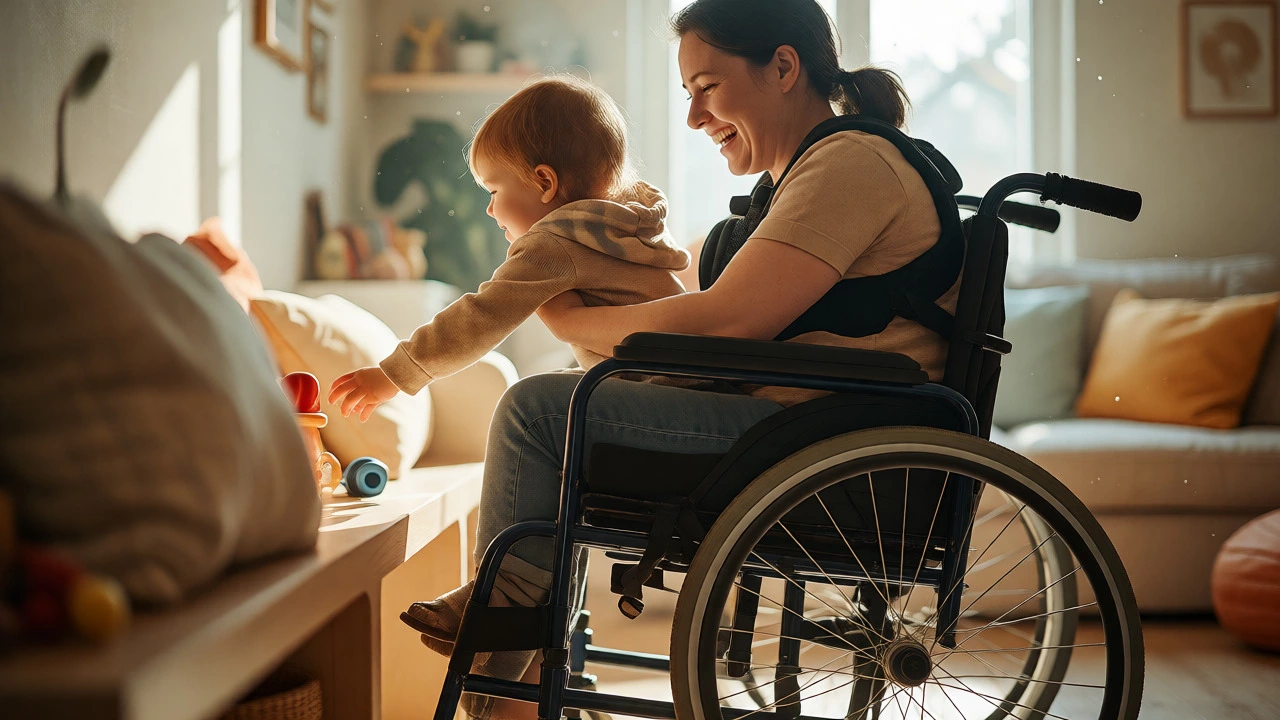
Let’s step away from the double helix for a second. Can someone who uses a wheelchair change diapers faster than someone who doesn’t? Maybe not initially. But does that make them a worse parent? No. It makes them a different parent. And different is fine.
People with special needs often develop incredible problem-solving skills early in life. If you’ve spent years navigating a world not built for you, you know how to advocate, how to modify environments, and how to ask for help. These are premium parenting traits. Think about it: a parent who knows how to navigate bureaucracy for disability services will likely be fierce advocates for their child’s educational needs, too.
However, we must be realistic about energy and resources. Parenting is physically demanding. If you have a chronic pain condition or limited mobility, the sheer volume of lifting, carrying, and chasing toddlers requires planning. This is where assistive technology shines. From baby carriers designed for back support to voice-activated home systems that let you monitor a sleeping infant without getting up, tech bridges the gap. It’s not cheating; it’s smart engineering applied to family life.
The Social Stigma: Who Decides What Makes a Good Parent?
Society has a weird obsession with "normalcy." When a person with visible disabilities becomes a parent, strangers often feel entitled to comment. "Will the grandparents help?" "Is the dad really the biological father?" These microaggressions add stress. Research shows that parents with disabilities face higher scrutiny from social services. They aren’t judged on their love, but on their ability to perform tasks in a neurotypical, able-bodied way.
This bias affects self-esteem. If you constantly hear that you’re a burden, you might hesitate to have kids. But consider this: children raised by parents with disabilities often develop higher levels of empathy and resilience. They learn early that everyone has struggles and that asking for help is a strength, not a weakness. In a world increasingly focused on emotional intelligence, these are valuable lessons.
Financial and Support Systems: The Hidden Job Requirements
Let’s talk money. Having a child is expensive. For people with special needs, costs can be higher due to medical needs, assistive devices, or potential care requirements. If you rely on government support or disability pensions, adding a dependent can complicate eligibility rules. In Australia, for example, parenting payments interact with Disability Support Pension rates in specific ways. You need to run the numbers before you buy the crib.
But money isn’t the only resource. Your "village" matters more now than ever. Do you have a network of friends, family, or community members who can step in when you’re exhausted? For parents with disabilities, a robust support network isn’t a luxury; it’s infrastructure. It’s the friend who picks up the groceries when you’re having a bad health day, or the neighbor who watches the toddler while you attend a therapy appointment.

Making the Decision: A Checklist for Readiness
If you’re weighing this decision, ignore the opinions of nosy relatives. Focus on these concrete factors:
- Medical Clarity: Have you seen a genetic counselor? Do you know the actual statistical risk of inheritance for your specific condition?
- Physical Adaptation: Can you modify your home and routines to manage childcare tasks safely? Test it out with a doll or a friend’s kid before committing.
- Support Network: Identify at least three people who can provide consistent, reliable help. Write down their names.
- Financial Stability: Create a budget that includes emergency funds for both your health and the child’s needs.
- Emotional Resilience: Are you prepared to handle intrusive questions from strangers? Can you shut down judgment with confidence?
There is no universal "right" age or status for parenthood. Some people find their capacity for caregiving grows as they age and gain stability. Others feel ready in their twenties. The key is alignment between your capabilities and your desires.
Final Thoughts: Love Over Logic
At the end of the day, biology gives us probabilities, but humans give us meaning. A child doesn’t need a parent who can run a marathon. They need a parent who shows up, who listens, and who loves unconditionally. People with special needs have been doing exactly that for generations. The question isn’t whether you should have kids because of your diagnosis. The question is whether you want to build a family, and if you have the support to make it work. If the answer is yes, then go for it. Just bring a good genetic counselor and a strong support team along for the ride.
Can people with intellectual disabilities raise children effectively?
Yes, many people with intellectual disabilities raise children successfully. Success depends less on IQ scores and more on the availability of practical support, stable housing, and access to parenting education programs tailored to individual learning styles. With the right scaffolding, they provide loving, stable homes.
Does having autism increase the risk of my child being autistic?
Yes, there is a genetic component. If one parent is autistic, the likelihood of their child being autistic is significantly higher than the general population, estimated between 10% and 20%. However, it is not guaranteed, and many autistic parents have neurotypical children. Early intervention can help regardless of outcome.
What is the role of genetic counseling in this process?
Genetic counselors analyze family history and specific diagnoses to calculate precise inheritance risks. They explain options like prenatal testing or preimplantation genetic diagnosis (PGD). They do not tell you what to do; they provide the data so you can make an informed reproductive choice.
Are there legal barriers for people with disabilities becoming parents?
Legally, adults with disabilities have the same rights to procreate as anyone else. However, in custody disputes or child welfare investigations, biases may lead to disproportionate scrutiny. Documentation of support networks and adaptive strategies can help protect parental rights.
How does financial aid change when having a child with a disability?
Many countries offer additional benefits for children with disabilities, such as higher tax credits or disability allowances. Parents should consult local social security guidelines to understand how a new dependent affects existing disability payments to avoid unexpected reductions.