
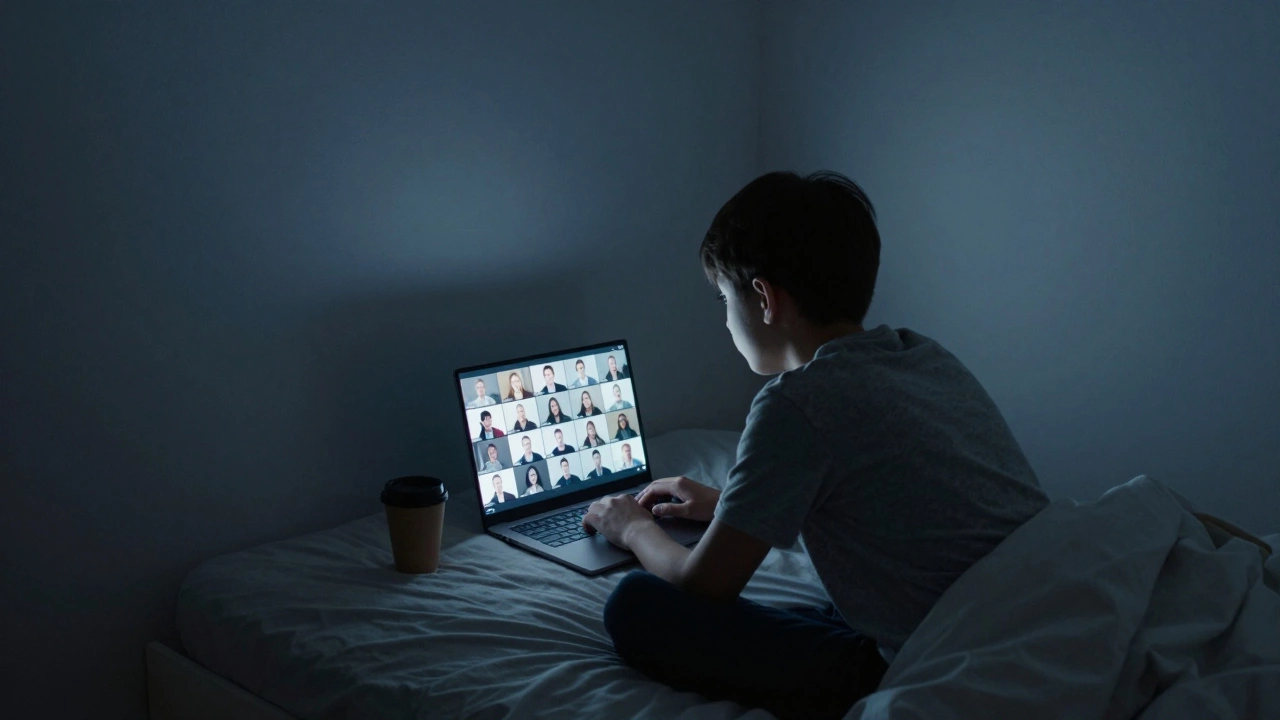
Online Learning Isolation Assessment
This assessment helps you understand how loneliness impacts your online learning experience. Based on research from the University of Melbourne and MIT, answer these 5 questions honestly to see your personal impact level.
Your Results
Your score: /50
Recommended Actions
One of the quietest, most common problems with online classes isn’t about technology, internet speed, or confusing platforms. It’s the loneliness. Not the kind you feel on a weekend night, but the deep, slow kind that creeps in when you’re sitting alone in your room, staring at a screen for hours, with no one around to say, "Hey, how’s it going?"
The Invisible Wall Between You and Your Class
When you go to a physical classroom, you don’t just learn. You bump into people. You share a laugh over a bad joke the professor made. You notice someone struggling and ask if they need help. You see the same faces every day, and over time, you start to feel like part of a group. Online, that doesn’t happen. You turn on your camera, say "hi," and then mute yourself. You might see 20 faces on screen, but you don’t really see them. You’re not sharing space-you’re sharing pixels.
Research from the University of Melbourne in 2024 tracked over 1,200 adult learners in online degree programs. One finding stood out: after just six weeks, 68% of students reported feeling disconnected from their peers. By week 12, nearly half said they rarely reached out to classmates outside of required group work. That’s not laziness. It’s human nature. We bond through small, unscripted moments-and online classes erase those.
Why Motivation Crashes Without the Routine
Think about how you used to get to class. You woke up, got dressed, walked or drove somewhere, sat in a chair, and then started learning. That routine was a signal to your brain: "It’s time to focus."
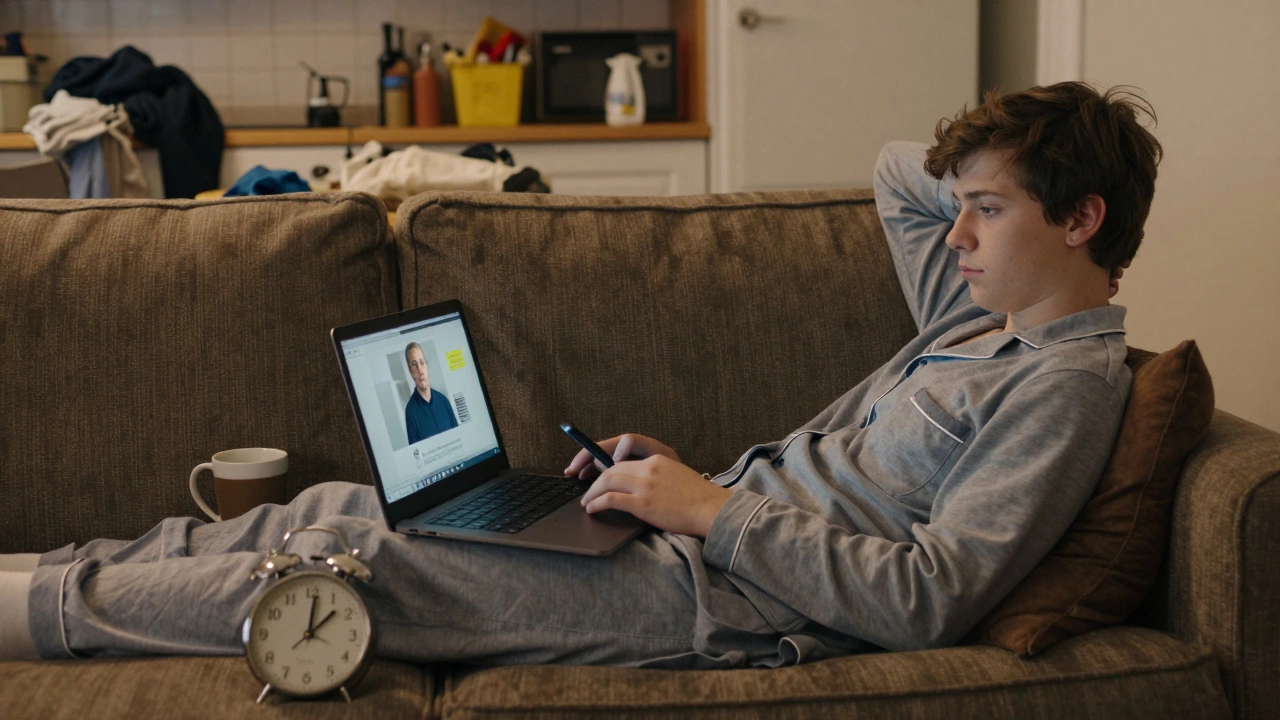
Online learning removes all of that. You wake up in your pajamas. You open your laptop on the couch. You pause to make coffee. You check your phone. You start the lecture… then get distracted by a text. An hour later, you realize you haven’t taken a single note.
This isn’t about willpower. It’s about environment. A 2025 study from MIT’s Learning Innovation Lab showed that learners who had a dedicated workspace-separate from their bed or kitchen-were 3.2 times more likely to complete assignments on time. But most people don’t have that luxury. Especially if they’re working, parenting, or living in small spaces. Without structure, motivation fades fast.
Feedback Feels Like It’s Coming from a Robot
When you hand in an essay in person, your professor might glance up, say, "This part is strong," and then lean in to explain why. You see their expression. You feel the conversation. Online? You get a grade. A comment. Maybe a rubric. Sometimes, nothing at all.
There’s no tone. No eye contact. No "Hey, I noticed you’ve been improving-keep going." That kind of human feedback is powerful. It doesn’t just correct mistakes. It makes you feel seen. When that’s gone, students start to wonder: "Does anyone even care?"
A survey of 850 online students across Australia, Canada, and the U.S. found that 61% felt their instructors seemed "distant" or "unavailable." Even when professors replied quickly, the lack of warmth made feedback feel mechanical. One student wrote: "I got a 92% on my final paper. The comment said, 'Good analysis.' That’s it. I felt like I’d just submitted a report to a vending machine."
It’s Hard to Ask for Help When You’re Alone
How many times have you hesitated to raise your hand in class? Probably more than you admit. Now imagine doing it online. You have to unmute. Type a question into the chat. Wait. Hope someone notices. Pray the instructor doesn’t move on.
Real-time confusion gets buried. You don’t understand a concept? You might wait days to email your professor. By then, the next topic’s been covered. You fall behind. You feel stupid. You start to avoid the class altogether.
There’s no quick side conversation. No "Wait, can you go over that again?" whispered to the person next to you. Online, asking for help feels like a big, awkward, high-stakes move. So many students just… stop asking.
The Long-Term Cost: Skills You Don’t Learn
Online classes teach you the subject. But they don’t teach you how to show up. How to network. How to read a room. How to speak up in a group. How to handle a tense conversation.
Employers know this. A 2025 survey of 500 hiring managers in Australia found that 74% were less confident in candidates who had completed their entire degree online-especially if they had no internships or in-person work experience. Not because the knowledge was lacking. But because soft skills like collaboration, adaptability, and communication are harder to prove when you’ve never been in the same room as your team.
You can learn Python online. You can master accounting formulas. But can you lead a Zoom meeting? Can you read the silence in a virtual room? Can you recover when someone misunderstands you? Those aren’t in the syllabus. But they’re in the job description.
What Can You Do About It?
It’s not all hopeless. You can fight the isolation. You just have to be intentional.
- Create a daily routine-even if it’s just getting dressed and sitting at a desk for 30 minutes before class.
- Join a study group. Not a Zoom one. A real one. Meet in a library, café, or park. Even once a week.
- Ask for feedback. Don’t wait for it. Send your professor a quick message: "I’m working on this part and want to make sure I’m on track. Could I send you a draft?"
- Use video. Turn your camera on. Even if you’re quiet. Seeing faces makes them real.
- Find a study buddy. Someone who’s also struggling. Text them once a day. Just to say, "Still here."
Online learning isn’t broken. But it’s missing something human. And if you don’t find a way to bring that back, you’ll walk away with a certificate-but not the confidence, connections, or skills that really matter.
Is isolation the only downside of online classes?
No, but it’s the most common and hardest to notice. Other downsides include technical issues, time management challenges, lack of hands-on practice for certain subjects, and difficulty staying motivated. But isolation cuts deeper because it affects your mental health, your sense of belonging, and your ability to engage with others-even after the class ends.
Do online classes work for everyone?
They work well for people who are self-directed, have a quiet space, and already have strong social support outside of class. But for those juggling jobs, kids, or unstable living situations, the lack of structure and connection can make online learning feel overwhelming. It’s not a one-size-fits-all solution.
Can online classes ever replace in-person learning?
For some subjects, yes-like math, coding, or history. But for others, no. Labs, clinical training, art, music, debate, and teamwork-heavy fields need physical presence. Even in fields where online works, the human elements-mentorship, peer feedback, spontaneous collaboration-are lost. Online is a tool, not a replacement.
Why don’t schools fix this problem?
Many institutions are trying, but it’s expensive and hard to scale. Hosting virtual coffee hours, peer mentoring, or in-person meetups costs money and staff time. Most online programs prioritize enrollment numbers and cost-efficiency over student connection. The system is built for convenience, not community.
I’m already in an online class. Is it too late to change things?
Not at all. Start small. Reach out to one classmate. Ask them to study together once a week. Turn on your camera. Join a student group. Talk to your instructor about your experience. You’re not alone in feeling this way-and taking one step can change how you feel about the whole experience.