

Tutoring Expectations Checker
How Your Tutor Stacks Up
Answer these questions to see if your tutoring arrangement meets the key indicators of quality tutoring from the article.
When you hire a private tutor, you’re not just paying for someone to repeat what the teacher said in class. You’re investing in a personalized learning experience - but only if you know what to actually expect. Too many families assume tutoring means instant grades improvement or that the tutor will magically fix years of confusion in a few weeks. That’s not how it works. Real tutoring is slower, messier, and far more powerful than most people think.
You’ll Get a Learning Plan, Not Just Answers
The first session isn’t about solving homework. It’s about figuring out what’s broken. A good tutor will ask questions: How do you study? What part of math makes you freeze up? When was the last time you felt confident in science? They’ll look at past tests, quiz scores, even how you take notes. This isn’t fluff - it’s diagnostics.By the end of session one, you should walk away with a clear, written plan. Not a vague promise like "we’ll get you better at algebra." But something specific: "We’ll rebuild your understanding of linear equations using real-life examples, starting with graphing slope from your favorite sports stats. We’ll do three problems a week, check in every Friday, and track your confidence level on a scale of 1 to 10."
That’s the difference between a tutor and a homework helper. One gives you answers. The other rebuilds your foundation.
Progress Is Measured in Confidence, Not Just Grades
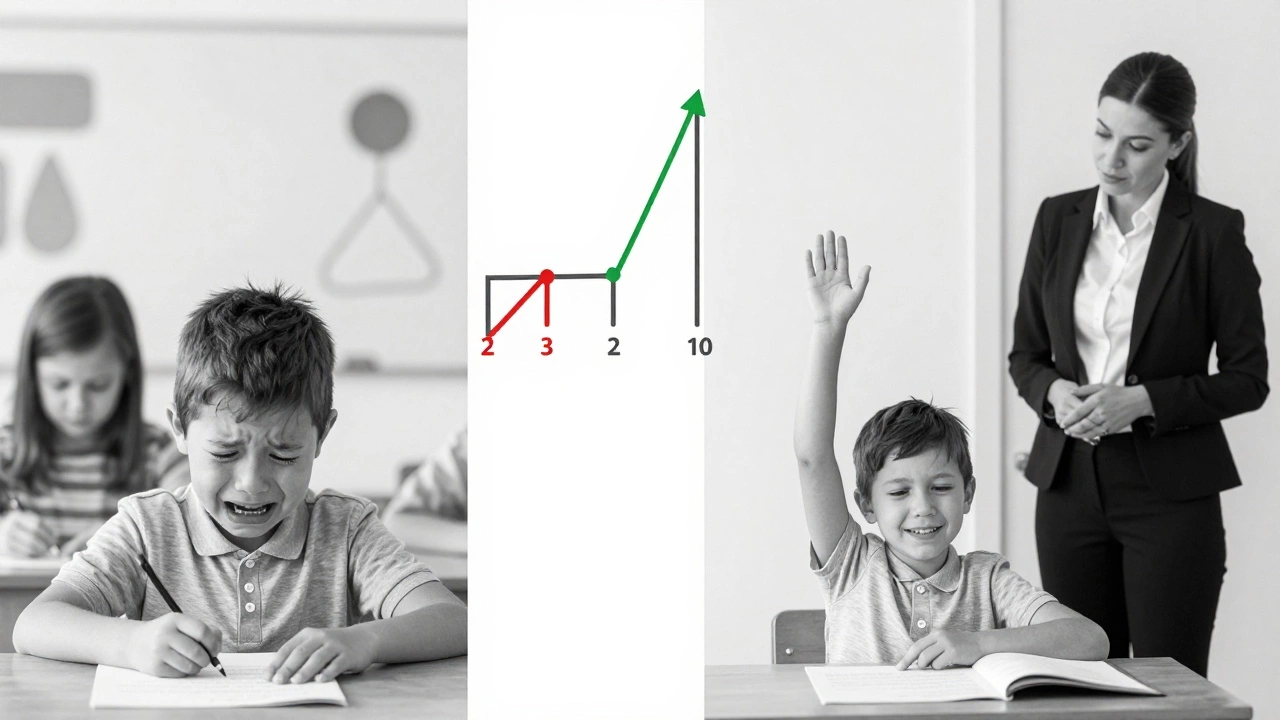
You might not see a B turn into an A after three weeks. But you’ll notice something quieter - and more important. Your kid stops saying "I can’t do this" and starts saying "Let me try again." That’s progress. That’s what tutors are really after.One parent in Adelaide told me her daughter, who used to cry before every chemistry test, started raising her hand in class after six weeks of tutoring. She didn’t go from a C to an A - but she stopped avoiding participation. That shift? That’s the real win. Tutors track confidence, engagement, and willingness to take risks. Those are the skills that lead to long-term success, not just a single exam score.
Homework Help Is Only a Small Part
It’s tempting to think tutoring means the tutor will sit with your child and walk them through their assignment. But that’s like hiring a personal trainer just to watch you do push-ups. You’re paying for expertise, not supervision.A good tutor will spot patterns in mistakes. If your child keeps misapplying the quadratic formula, the tutor won’t just correct it - they’ll trace it back to a misunderstanding of negative numbers from Year 7. They’ll pull out old worksheets, reteach the concept with a different analogy, and give practice problems that feel totally unrelated to the current homework. That’s how learning sticks.
Don’t expect your tutor to do your child’s homework. If they do, you’re paying for a shortcut, not a solution.

The Tutor Is a Coach, Not a Replacement Teacher
Private tutors don’t replace school. They fill the gaps school doesn’t have time for. A classroom teacher has 30 students. A tutor has one. That’s the advantage - but it’s not magic.Your tutor will help your child understand why the Pythagorean theorem matters in real life - maybe by calculating the shortest path across a park. They’ll connect biology to their interest in soccer by explaining how oxygen flows through muscles during a match. They’ll make abstract ideas feel concrete.
But they won’t teach the entire curriculum for you. They won’t cover every topic your child’s school assigns. They’ll focus on the weak spots, the ones that are holding everything else back. If your child is struggling with fractions, the tutor won’t waste time on advanced trigonometry. They’ll go back to basics. And that’s okay.
Consistency Beats Intensity
You might think cramming for two hours every weekend before a test is the best approach. It’s not. Learning builds slowly. Think of it like learning to ride a bike. You don’t get better by falling off ten times in one day. You get better by riding a little every day.Most effective tutoring happens in 45- to 60-minute sessions, once or twice a week. That’s enough time to dig into a concept, practice it, and let it sink in - without overwhelming the student. Weekly consistency beats marathon weekend sessions every two weeks. The brain needs time to process. Skipping weeks means starting over.
Some parents hire tutors only when exams are near. That’s like waiting until your car is broken down to check the oil. You’ll pay more, stress more, and get less results.
Communication Is Key - But It’s Not Always Verbal
You won’t get a detailed report after every session. But you should get regular updates. A good tutor will send a quick email every few weeks: "We’ve been working on factoring polynomials. She’s now able to identify common factors on her own, but still hesitates with signs. We’re using a color-coding system to help. Next week: word problems."That’s the kind of detail that matters. It tells you they’re paying attention. It tells you what’s working. It tells you what’s still hard.
Don’t expect a tutor to call you every week unless you ask. But do ask. If they’re not offering updates, you’re not getting the full value. And if they’re sending long, jargon-filled reports? That’s a red flag. You don’t need academic language. You need clarity.
It’s Not Always Easy - And That’s Normal
There will be weeks when your child resists. When they say "I hate math," or "The tutor doesn’t get me." That’s part of the process. Learning is uncomfortable. A good tutor doesn’t avoid that discomfort - they work through it.They’ll adjust their tone. They’ll change the examples. They’ll let your child fail in a safe space. That’s how real growth happens. If your tutor always makes things easy, they’re not teaching - they’re comforting.
And sometimes, the tutor won’t be the right fit. That’s okay. Not every tutor works for every student. It’s not a failure. It’s a mismatch. If after four sessions you still feel like your child is just sitting there nodding along, it’s time to try someone else. The right tutor will feel like a guide - not a boss.
What You Should Never Expect
- Instant results. Real change takes weeks, not days.
- Guaranteed top grades. No tutor can control how a teacher grades or how hard the test is.
- A tutor who does the work for your child. That’s cheating - and it teaches nothing.
- A tutor who ignores your child’s learning style. If your kid is visual and the tutor only talks? That’s not working.
- A tutor who doesn’t check in with you. You’re paying for partnership, not just service.
What You Should Expect Instead
- A tutor who listens more than they talk.
- A plan that adapts as your child grows.
- Progress that shows up in attitude before it shows up on paper.
- Confidence that outlasts the exam.
- Someone who treats your child like a person, not a problem to fix.
If you walk away from tutoring feeling like your child is more curious, more willing to try, and less afraid of being wrong - you’ve gotten exactly what you paid for.
How long should tutoring sessions last?
Most effective sessions are 45 to 60 minutes long. Shorter sessions don’t allow enough time to dig into concepts. Longer ones lead to burnout. For younger students or those with attention challenges, 30-minute sessions can work - but they should happen twice a week instead of once.
Should I be in the room during tutoring?
For students under 12, it’s often helpful to be nearby, especially in the first few sessions. But for teens, being present can make them self-conscious. A good tutor will ask for your preference and adjust. The goal is to create space where your child feels safe to ask questions - even the silly ones.
Can a private tutor help with study skills?
Yes - and they should. Many students struggle not because they don’t understand the material, but because they don’t know how to study it. A good tutor will teach note-taking, time management, how to break down big assignments, and how to review effectively. These skills transfer to every subject.
How do I know if my tutor is any good?
Look for three things: Do they ask about your child’s interests? Do they track progress beyond test scores? Do they explain things in more than one way? If the answer is yes, you’re in good hands. If they only answer questions without probing deeper, or if they blame your child for not understanding - walk away.
Is online tutoring as effective as in-person?
For most students, yes - especially if the tutor uses shared digital whiteboards, screen sharing, and interactive tools. The key isn’t the location - it’s the connection. If your child feels heard and challenged, it doesn’t matter if they’re in Adelaide or online from Perth. Many tutors now use tools like Jamboard or Notability to make virtual sessions feel hands-on.