

Rigorous Course Load Checker
How Strong Is Your Course Load?
Ivy League schools don't prefer AP over IB - they care about how you challenge yourself within your school's offerings. This tool evaluates if your course load shows the academic rigor that admissions officers look for.
Your Course Load Analysis
When you’re applying to an Ivy League school, every detail matters. Your GPA, essays, extracurriculars - and yes, your high school curriculum. But here’s the question that keeps students up at night: Do Ivy Leagues prefer AP or IB? The truth isn’t as simple as picking one over the other. It’s about how you use what’s available to you.
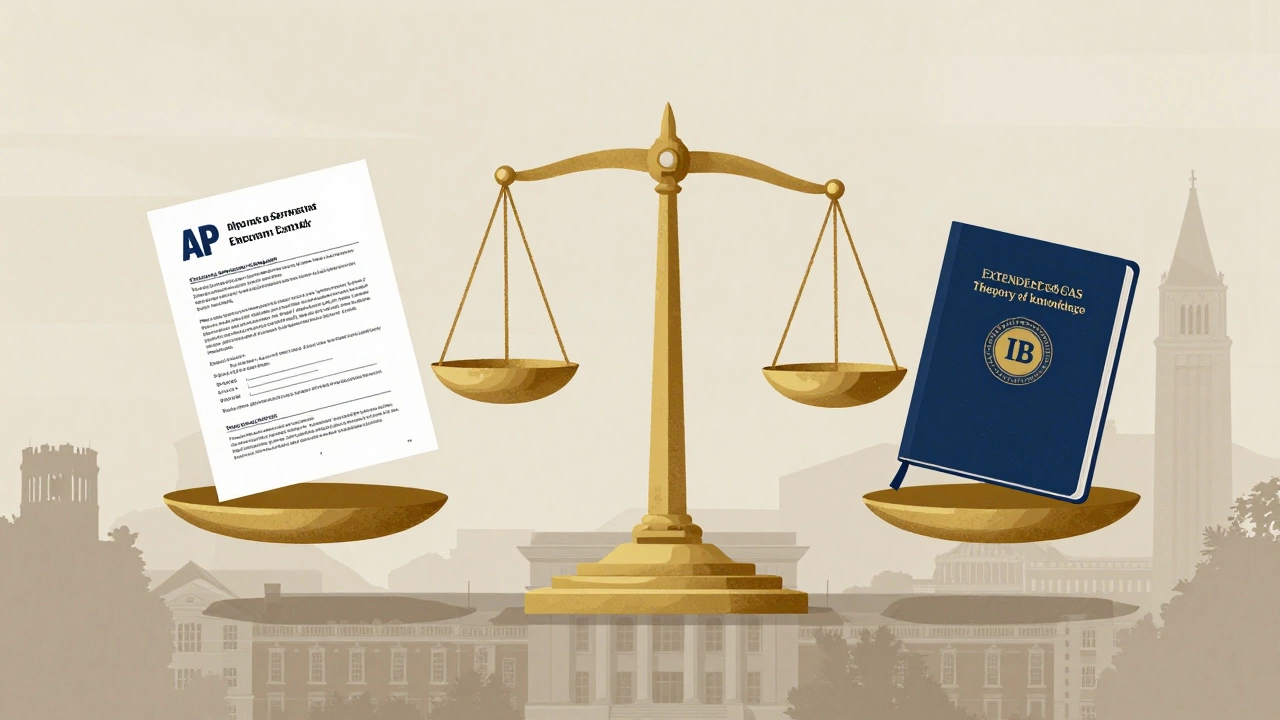
AP and IB Are Both Respected - But They’re Not the Same
Advanced Placement (AP) and the International Baccalaureate (IB) Diploma Programme are both rigorous, college-level courses recognized by top universities. But they’re built differently. AP is a collection of individual subject exams. You pick the classes you want, study for the test, and if you score a 4 or 5, you might earn college credit. IB is a full two-year curriculum with six subject areas, a theory of knowledge course, extended essay, and creativity-action-service (CAS) requirements. It’s holistic. AP is modular.
Ivy League admissions officers don’t say, “We only want IB students.” They say, “We want students who challenge themselves within the context of their school.” That’s the key phrase: within the context of their school.
If your high school only offers AP, and you take 8 of them with top scores, you’re not at a disadvantage. If your school only offers IB, and you earn the full diploma with a 40+ score, you’re not automatically favored. What matters is that you pushed yourself to the limit of what your school offers.
What Ivy League Admissions Officers Actually Say
Harvard’s admissions office has published clear guidance: “We do not have a preference for AP or IB. We evaluate each applicant in the context of the educational opportunities available to them.” Princeton, Yale, and Columbia echo the same message. Stanford’s admissions blog says, “We’re looking for intellectual curiosity - not a checklist of courses.”
That means if you’re at a public school in rural Ohio with no IB program, and you take every AP class offered - including AP Physics C, AP Calculus BC, and AP English Literature - you’re showing initiative. If you’re at an international school in Singapore with IB, and you take HL Math, HL Chemistry, and HL History, you’re showing depth. Neither is better. Both are valid.
But here’s the twist: IB students tend to have more well-rounded profiles because of the CAS and extended essay requirements. AP students often focus on subject mastery. Neither is superior - but if you’re applying to a school like Brown or Dartmouth, which values interdisciplinary thinking, the IB’s structure might align more naturally with their philosophy.
How Ivy Leagues Treat AP and IB Scores
Let’s talk credit. This is where the difference becomes practical. Most Ivy League schools accept AP scores of 4 or 5 for credit. For IB, they usually require a 6 or 7 in Higher Level (HL) courses. Standard Level (SL) IB courses rarely earn credit.
For example:
- Harvard grants credit for AP 5 and IB HL 7
- Princeton accepts AP 5 and IB HL 6 or 7
- Columbia requires AP 5 and IB HL 7 for credit
- Yale accepts AP 5 and IB HL 6 or 7
So if you’re aiming to skip intro courses in college, IB HL scores need to be higher than AP scores. That’s not a bias - it’s just how the programs are scaled. IB HL exams are harder, so colleges set the bar higher.
But here’s what most students don’t realize: credit isn’t the goal. The goal is admission. And admission doesn’t depend on whether you earned credit for Calculus - it depends on whether you showed you could handle college-level work in the first place.
What Schools Actually Look For in Your Course Load
Admissions officers don’t count how many APs or IBs you took. They look at patterns. Did you take increasingly difficult courses over four years? Did you challenge yourself in core subjects - math, science, English, history - or did you stack easy electives? Did you take a language beyond the minimum requirement? Did you take a lab science in 11th grade, or did you wait until senior year?
Let’s say you’re a student from Texas with a strong AP program. You took AP Biology, AP Chemistry, AP Physics 1, AP Calculus BC, AP Statistics, AP English Language, AP U.S. History, and AP Psychology. That’s eight APs. You got 5s on all of them. You’re not just competitive - you’re in the top tier.
Now imagine a student from London with IB. They took IB HL Biology, HL Chemistry, HL Math Analysis, SL English A, SL History, and SL Spanish. They wrote a 4,000-word extended essay on climate policy, completed 150 hours of CAS, and scored a 41/45. They’re equally competitive.
The difference? The IB student’s application tells a story about balance. The AP student’s tells a story about mastery. Both are compelling. Neither is better.
What Happens When You Mix AP and IB?
Some schools - especially private or international ones - offer a hybrid model. You might take IB courses but sit for AP exams instead. Or you might do IB standard level and supplement with AP classes.
Admissions officers see this. And they don’t penalize it. In fact, they often admire it. If your school doesn’t offer IB HL Physics, but you self-studied for the AP Physics C exam and scored a 5, that shows initiative. If you’re in an IB school but your school doesn’t offer IB Economics, and you take an AP Economics course online and ace it - that’s a red flag turned into a green light.
What they don’t like: padding your transcript with easy classes just to boost your GPA. Taking AP Environmental Science because it’s “easy,” while avoiding harder math or science, raises eyebrows. Taking IB HL Art when you’ve never taken an art class before? That’s a stretch. Admissions officers can spot when a course is chosen for convenience, not passion.

Real Examples From Admitted Students
Let’s look at two real applicants from 2025:
- Maria, from Mexico City: Attended a public school with no IB program. Took 10 AP courses - including AP Physics C, AP Chemistry, AP Calculus BC, AP Spanish Literature, and AP U.S. History. Scored 5s on all. Won national science fair. Admitted to Cornell.
- Leo, from Stockholm: Attended an IB World School. Completed full IB Diploma with 42/45. Took HL Math, HL Physics, HL Economics. Wrote extended essay on quantum computing ethics. Volunteered at a local tech nonprofit. Admitted to Columbia.
Neither had the “perfect” program. But both maximized what they had.
What You Should Do Right Now
If you’re in high school and thinking about AP vs IB:
- Don’t switch programs just to impress colleges. If your school offers IB and you’re doing well, stick with it. If you’re in a school with strong AP options, go deep there.
- Don’t take a course just because it’s “hard.” Take courses that align with your interests and future goals. If you want to study engineering, take calculus and physics - not just the most APs.
- Don’t ignore the non-academic parts of IB. If you’re doing IB, treat CAS and the extended essay like serious work. They’re not busywork - they’re proof you can think independently.
- Don’t stress about credit. Focus on admission. You can always skip classes in college later. But you can’t go back and take harder courses if you didn’t challenge yourself now.
Bottom Line: It’s Not About AP or IB - It’s About You
Ivy League schools don’t have a secret preference for AP or IB. They care about intellectual curiosity, resilience, and the ability to think deeply. Whether you’re taking AP exams in a small-town school or completing an IB diploma in a global city, what matters is that you didn’t just show up - you showed up prepared to grow.
So stop asking which is better. Start asking: What’s the most challenging path I can take with the resources I have? That’s the question that gets you in.
Do Ivy Leagues accept IB without the full diploma?
Yes. Ivy League schools evaluate individual IB courses, even if you don’t complete the full diploma. HL courses with scores of 6 or 7 are treated as strong indicators of academic readiness. You’ll still be considered competitive if you’ve taken 3-4 HL courses and performed well.
Is it better to take more AP classes or focus on fewer IB HL courses?
Focus on depth over quantity. Taking five APs and getting 5s is stronger than taking eight APs with 3s. Similarly, three strong IB HL courses with 7s are better than six SL courses with 5s. Admissions officers look for mastery, not volume.
Can I take AP courses if my school only offers IB?
Yes - many IB students take AP exams independently, especially in subjects not offered at their school. Colleges respect initiative. If you self-study for AP Physics C and score a 5, it shows drive and discipline - traits top schools value.
Does taking IB hurt my chances if my school doesn’t offer AP?
No. Admissions officers are trained to understand the differences in school offerings. If your school only offers IB, they expect you to take full advantage of it. A full IB diploma with strong scores is seen as one of the most rigorous high school credentials available.
Should I drop AP to do IB, or vice versa?
Only if you’re genuinely better suited to the other program. Don’t switch just because you think one is “more prestigious.” If you’re already succeeding in AP and enjoy the flexibility, stay. If you thrive in structured, interdisciplinary learning, IB might be a better fit. Your performance and engagement matter more than the label.