

University Ranking Selector Tool
Not all rankings are created equal. Select your primary goal below to discover which ranking methodology best serves your needs.
Undergrad & Jobs
I want a degree that opens doors for employment immediately after graduation.
PhD & Research
I am pursuing a doctorate or a career in pure scientific research.
Teaching Quality
I value the classroom experience, staff ratios, and a balanced view.
US & Medical
I am looking at North American schools or medical/science faculties.
Select an option above
RecommendationClick on one of the cards above to see which ranking methodology matches your goals.
You are looking at a list of universities. One says Harvard is number one. Another puts MIT on top. A third ranks Oxford higher than both. Which one tells the truth? The short answer is: none of them perfectly. But some are much better suited for your specific needs than others.
University rankings are not scientific measurements like temperature or weight. They are complex algorithms that mix data points about research, reputation, and teaching. If you pick the wrong ranking, you might choose a school that looks great on paper but fails to support students like you. Let’s break down which ranking actually matters for you, based on what you want from your education.
The Big Four: Who Makes the Lists?
Most people rely on four major global rankings. Each has a different philosophy. Understanding these philosophies is more important than memorizing the numbers.
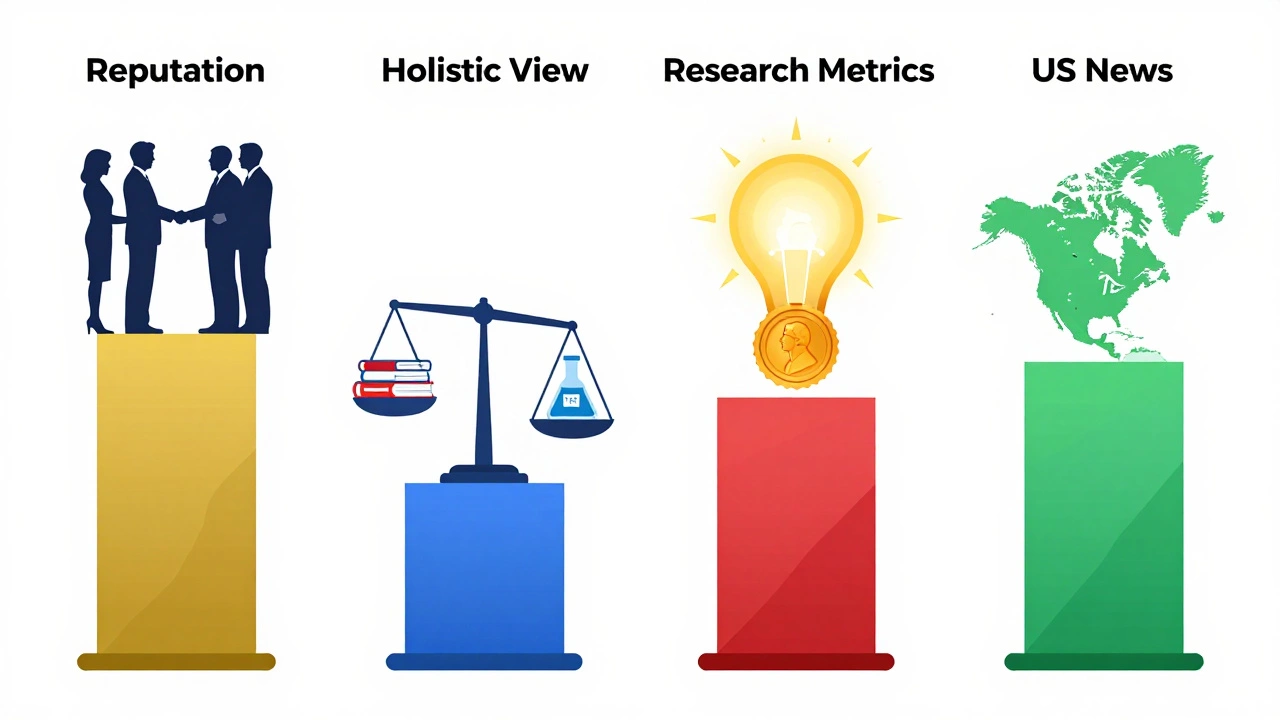
QS World University Rankings is published by Quacquarelli Symonds, a British company specializing in international student recruitment. It leans heavily on academic and employer reputation surveys. This means it measures how well-known a university is among professors and hiring managers. For students who care about brand recognition and job prospects immediately after graduation, QS is often the most relevant metric.
Times Higher Education (THE) World University Rankings is produced by the British weekly magazine Times Higher Education. THE uses a balanced mix of teaching environment, research output, citations, international outlook, and industry income. It is widely considered the most holistic general-purpose ranking because it tries to weigh teaching quality alongside research prestige.
Academic Ranking of World Universities (ARWU), also known as the Shanghai Ranking, is published by Shanghai Jiao Tong University. This is the oldest global ranking, launched in 2003. It focuses almost entirely on hard research metrics: Nobel Prizes, Fields Medals, highly cited researchers, and publications in top journals. It ignores teaching quality and student satisfaction completely. If you are aiming for a PhD or a career in pure research, ARWU is the gold standard.
U.S. News & World Report Best Global Universities is a ranking service originally focused on American colleges, now expanded globally. It relies heavily on global research reputation and bibliometric indicators. It is particularly useful if you are comparing institutions within North America or looking at schools with strong medical and scientific research outputs.
Why No Single Ranking Is "Accurate"
The problem with asking for the "most accurate" ranking is that accuracy depends on your definition of success. A university can be world-class at curing cancer but terrible at teaching introductory sociology. Conversely, a college might have an incredible campus culture and high graduate employment rates but publish zero groundbreaking papers.
Consider this scenario: You are an undergraduate student interested in business. You look at ARWU. It ranks a massive research university #10 because its physics department won three Nobel Prizes last year. However, that same university has large lecture halls, outdated business curriculum, and low student engagement. Meanwhile, a smaller liberal arts college ranked #150 offers small classes, direct mentorship, and a 95% job placement rate for its business grads. Which one is "better" for you? The ARWU ranking hides this nuance because it does not measure teaching quality.
This is why relying on a single list is dangerous. Rankings suffer from survivorship bias and methodological opacity. Some methods change yearly without warning, causing schools to jump or drop dozens of spots overnight. These fluctuations rarely reflect real changes in educational quality; they usually reflect tweaks in the algorithm.
| Ranking Body | Primary Focus | Best For | Major Weakness |
|---|---|---|---|
| QS | Reputation Surveys (Academic & Employer) | Undergraduates seeking global brand recognition and employability | Subjective survey data can be biased toward older, wealthier institutions |
| THE | Balanced Mix (Teaching, Research, Citations, International) | Students wanting a holistic view of university performance | Complex weighting makes it hard to isolate specific strengths |
| ARWU | Hard Research Metrics (Nobels, Citations, Publications) | PhD candidates and researchers in STEM fields | Ignores teaching quality, humanities, and social sciences largely |
| US News | Research Reputation & Bibliometrics | Comparing North American institutions and medical/science schools | Less emphasis on undergraduate experience and regional variations |
Choosing the Right Tool for Your Goal
To find the "accurate" ranking, you must first define your goal. Here is how to match your intent to the right data source.
If You Are an Undergraduate Student
Your primary concerns are likely tuition value, campus life, internship opportunities, and post-graduation employment. In this case, QS World University Rankings is often the most practical starting point. Why? Because the "Employer Reputation" component carries significant weight. Employers recognize brands. A degree from a QS Top 50 school often opens doors simply because HR departments use these lists as quick filters.
However, do not stop there. Look at subject-specific rankings. QS and THE both publish rankings by discipline. A university might be ranked #200 overall but #5 in Engineering. If you study Engineering, the overall rank is irrelevant noise. Always drill down into your specific field of study.
If You Are Pursuing a PhD or Research Career
For doctoral studies, reputation matters less than resources and publication record. Here, ARWU (Shanghai Ranking) becomes the critical tool. It identifies universities with the deepest pockets and the most prolific researchers. If you need access to advanced laboratories, funding, and mentors who are leaders in their field, follow the ARWU data. It tells you where the intellectual capital is concentrated.
Also consider citation impact. THE includes citation per faculty member as a key metric. This helps identify schools where individual professors are influential, even if the institution as a whole is not a giant research powerhouse.
If You Value Teaching and Student Experience
This is the hardest area to measure. Rankings struggle here because data is self-reported and subjective. Times Higher Education (THE) attempts to capture this through its "Teaching Environment" pillar, which looks at staff-to-student ratios and doctorate-to-bachelor degrees awarded. While imperfect, it is the best available proxy for teaching intensity among the big four.
For a deeper dive into student satisfaction, look beyond global rankings. National student surveys, such as the National Student Survey (NSS) in the UK or the National Survey of Student Engagement (NSSE) in the US, provide granular data on classroom interaction, academic support, and campus facilities. These local metrics are often more accurate predictors of your daily happiness than a global index.
The Hidden Biases in Global Rankings
You should be aware of systemic biases that skew these lists. First, there is a language bias. Most rankings favor English-speaking countries because the dominant academic journals are in English. Researchers in non-English speaking countries may produce excellent work but get fewer citations simply due to language barriers. This artificially deflates the scores of universities in Europe, Asia, and Latin America.
Second, there is a size bias. Large universities naturally generate more citations and have more Nobel laureates simply because they have more staff. A small, elite institute will always lose to a massive state university in raw volume metrics, even if the average quality of education at the small school is superior. This is why ARWU favors giants like Harvard, Stanford, and Cambridge disproportionately.
Third, there is a disciplinary bias. Science, Technology, Engineering, and Mathematics (STEM) fields dominate citation databases. Humanities and Social Sciences are undervalued in rankings that rely heavily on citation counts. If you are studying History, Philosophy, or Literature, a high ARWU rank tells you very little about the quality of your potential department.
How to Validate a University Beyond the Number
Once you have used rankings to create a shortlist, ignore the numbers. Start investigating the reality. Here is a checklist for deeper validation:
- Check Graduate Outcomes: Do not just look at "employment rate." Look at salary distribution and role relevance. Are graduates getting jobs in their field, or are they working in retail? Many universities report "any job" as successful employment, which inflates their stats.
- Review Curriculum Transparency: Can you find detailed course descriptions? Are modules updated recently? Outdated curricula are a red flag that the department is not engaged with current industry trends.
- Analyze Faculty Profiles: Look at the professors who will teach you. Are they active researchers? Do they have industry experience? A university with a few star professors but many adjuncts teaching intro classes may offer a diluted experience.
- Connect with Current Students: Use LinkedIn or social media to ask current students about their experience. Ask specific questions: "How responsive is the administration?" "Are labs well-equipped?" Their answers will reveal truths that no algorithm can capture.
- Consider Location and Cost: A lower-ranked university in a major economic hub may offer better internship opportunities than a top-ranked school in a remote town. Factor in the cost of living and potential part-time work income.

Regional vs. Global Context
Global rankings often fail to capture regional strength. A university might be ranked #500 globally but be the undisputed leader in its country or region. For example, in Australia, the Group of Eight (Go8) universities dominate domestic prestige and funding. Within this group, nuances matter more than global position. If you plan to work locally, a regional ranking or national accreditation status is far more predictive of your success than a global list.
In Europe, the European University Association provides alternative perspectives that emphasize teaching and societal impact over pure research output. In Asia, emerging economies are investing heavily in higher education, causing rapid shifts in rankings. Schools in China and Singapore have climbed dramatically in recent years due to massive state investment. This volatility means a ranking from two years ago may already be obsolete.
Final Thoughts on Using Rankings Wisely
Think of university rankings as weather forecasts, not laws of physics. They provide a probable trend based on historical data, but they cannot predict your personal experience. The "most accurate" ranking is the one that aligns with your specific definition of success. If you want fame, look at QS. If you want research depth, look at ARWU. If you want balance, look at THE.
Do not let a single number dictate your future. Use rankings to filter options, then dig deeper into the human elements: teaching quality, community, location, and career support. Your education is too important to be reduced to a spreadsheet cell. Take control of your research process, verify the data, and choose the institution that fits your life, not just the one that tops the list.
Is the QS ranking better than THE?
It depends on your goals. QS is better if you prioritize brand recognition and employer reputation, making it ideal for undergraduates seeking jobs. THE is better if you want a balanced view that includes teaching quality and research impact, making it suitable for a broader range of students, including those considering postgraduate research.
Why does my university rank differently on different lists?
Each ranking uses different metrics and weights. ARWU focuses on research awards and citations, so research-heavy universities score high. QS focuses on reputation surveys, so famous universities score high. THE balances teaching and research. A university strong in teaching but weak in research will rank lower on ARWU but potentially higher on THE.
Are university rankings biased against non-English speaking countries?
Yes, significantly. Most global rankings rely on citation data from English-language databases like Web of Science and Scopus. Research published in other languages is often excluded, leading to lower scores for universities in Europe, Asia, and Latin America, regardless of their actual quality.
Should I trust subject-specific rankings more than overall rankings?
Absolutely. Overall rankings are diluted by the performance of all departments. A university might be mediocre in arts but world-leading in engineering. Subject-specific rankings provide a much more accurate picture of the quality of education and research in your specific field of interest.
What is the most reliable ranking for PhD programs?
The Academic Ranking of World Universities (ARWU) is generally considered the most reliable for PhD programs, especially in STEM fields. It focuses on hard research metrics like Nobel Prizes and highly cited researchers, which directly correlate with the resources and mentorship available for doctoral candidates.