
Adult Learning Style Assessment
Answer these questions honestly to see if your current study habits are optimized for the adult brain or if you're stuck in traditional "childhood" learning modes.
Your Result:
Recommended Strategies for You:
Picture this: you’re trying to learn a new software tool at work. You watch the tutorial, read the manual, and try it out. It feels clunky. Now imagine a five-year-old picking up that same tool. They don’t read the manual. They poke buttons, break things, and figure it out through sheer curiosity and trial and error. Why is your brain resisting what their brain embraces?
The short answer is that adults and children are not just different sizes of the same learner. Their brains operate on fundamentally different hardware and software. Understanding these differences isn’t about judging one method as superior; it’s about using the right approach for the right stage of life. For adults, learning is less about absorption and more about application. If you’ve ever felt frustrated by traditional classroom methods or wondered why "just studying harder" doesn't always work, you’re running into the biological and psychological realities of adult cognition.
The Brain Hardware: Neuroplasticity vs. Neural Pruning
To understand how we learn, we first have to look at the physical changes happening inside our skulls. The term neuroplasticity refers to the brain's ability to reorganize itself by forming new neural connections throughout life. While both children and adults possess neuroplasticity, the nature of this plasticity shifts dramatically with age.
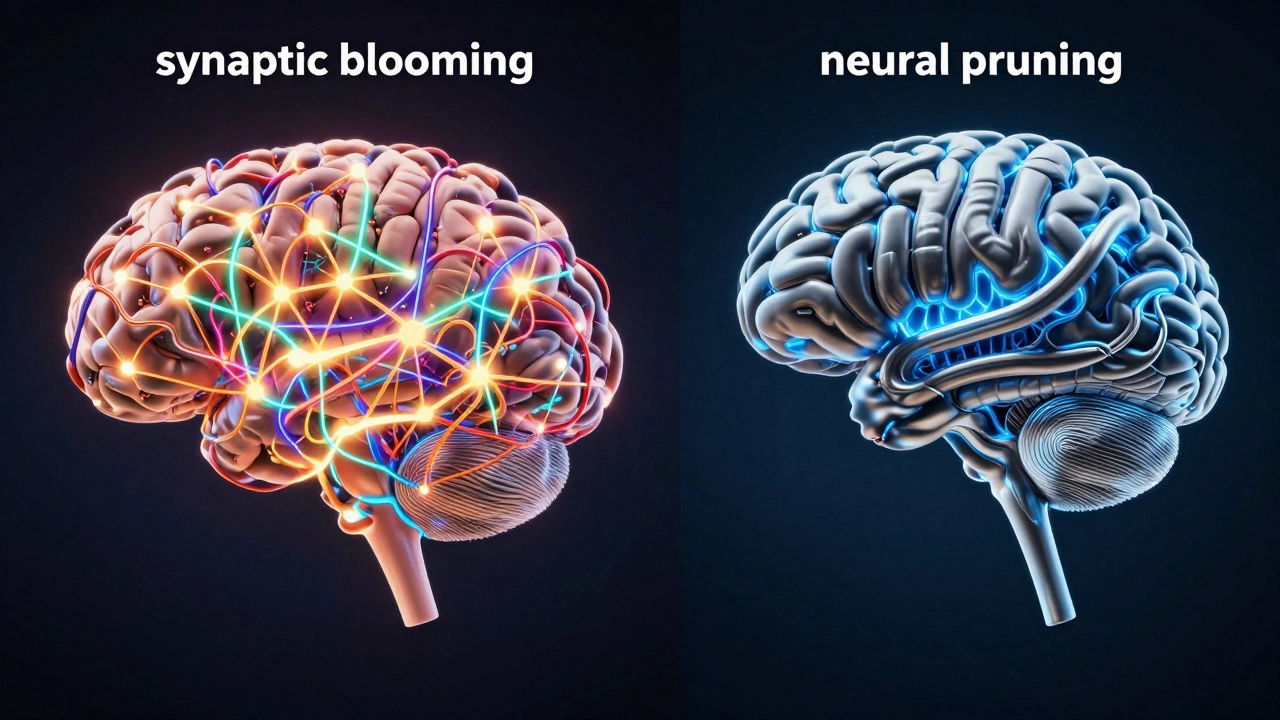
In childhood, the brain is in a state of massive expansion. It creates an overabundance of synaptic connections-a process called synaptic blooming. This allows children to absorb language, social cues, and motor skills almost osmotically. They are sponges. However, this comes with a cost: efficiency. As they grow, the brain undergoes synaptic pruning, where unused connections are eliminated to streamline processing. By adulthood, the brain is a highly optimized machine. It favors efficiency over exploration.
This optimization means adults have stronger myelination-the fatty sheath that insulates nerve fibers and speeds up signal transmission. An adult can process familiar information faster than a child. But when facing entirely new, unfamiliar concepts, the adult brain has to work harder to create new pathways because those "blank slate" areas have been pruned away. You aren’t losing intelligence; you’re gaining specialization. The challenge for adult learners is breaking out of established neural highways to build new ones, which requires more conscious effort and repetition than it did for a child.
Andragogy: The Science of Adult Learning
If pedogy is the art and science of teaching children, then andragogy is the framework for understanding how adults learn. Coined by educator Malcolm Knowles in the 1970s, andragogy rests on several core assumptions that distinguish adult learners from younger students.
The most significant difference is the role of self-concept. Children are dependent personalities; they look to teachers for direction and validation. Adults move toward a self-directed concept of self. We want to be responsible for our own decisions. When an adult is treated like a passive recipient of knowledge, resistance kicks in. We need autonomy. This is why corporate training sessions that feel like high school lectures often fail. The content might be good, but the delivery ignores the adult need for control over the learning process.
Another pillar is experience. Adults bring a reservoir of life experiences to the learning situation. This experience is a rich resource for learning through techniques such as discussion and problem-solving. However, it can also create biases. If you’ve learned a certain way of doing things for twenty years, unlearning that method is often harder than learning a new one from scratch. Children have no baggage. Adults do. Effective adult education leverages this existing knowledge base rather than ignoring it.
Motivation: Intrinsic vs. Extrinsic Drivers
Why do you learn? For a child, motivation is often extrinsic. Good grades, praise from parents, avoiding punishment, or earning a sticker chart reward. These external validators drive much of early education. As we mature, our motivation shifts inward. Intrinsic motivation becomes the primary engine for adult learning.
Adults are motivated by internal satisfactions such as the desire for increased job satisfaction, self-esteem, quality of life, or personal growth. More importantly, adults are driven by the need to solve problems. We are problem-centered rather than subject-centered. A child might study biology because it’s on the curriculum. An adult studies biology because they want to understand a health condition, improve their diet, or advance their career in healthcare.
This shift has profound implications for how we structure learning. If you want an adult to engage, you must connect the material to real-world outcomes immediately. Abstract theory without practical application is quickly discarded as irrelevant. The question "When will I ever use this?" is rarely asked by a child following instructions, but it is the constant filter for an adult learner.
| Characteristic | Child Learner (Pedagogy) | Adult Learner (Andragogy) |
|---|---|---|
| Self-Concept | Dependent on teacher/parent | Self-directed and autonomous |
| Experience | Limited; viewed as a deficit | Rich; viewed as a resource |
| Readiness to Learn | Determined by chronological age | Determined by life roles and tasks |
| Orientation | Subject-centered (abstract) | Problem-centered (practical) |
| Motivation | Extrinsic (grades, rewards) | Intrinsic (personal growth, utility) |

The Role of Prior Knowledge and Cognitive Load
Because adults have decades of accumulated knowledge, we face a unique challenge known as cognitive load. Our working memory is limited. When we encounter new information, our brain tries to fit it into existing schemas (mental models). If the new information fits, learning is easy. If it contradicts what we already believe, cognitive dissonance occurs.
For example, if you’ve spent ten years using a specific accounting software, learning a new platform isn’t just about memorizing new buttons. It’s about fighting the muscle memory and mental shortcuts of the old system. This interference effect slows down adult learning compared to a novice who has no prior habits to break. This is why "unlearning" is often cited as the hardest part of professional development.
However, prior knowledge also offers a massive advantage: scaffolding. Adults can link new concepts to well-understood ones. If you understand the basics of driving a car, learning to drive a truck is easier because you can map the similarities. Children lack this extensive network of analogies. Effective adult teaching uses metaphors and comparisons to bridge the gap between the known and the unknown.
Social Context and Collaborative Learning
Learning does not happen in a vacuum. For children, the classroom is a controlled social environment designed for peer interaction. For adults, the social context is often fragmented. We learn in isolation, online, or in brief workshops amidst busy schedules. Yet, humans are inherently social creatures, and collaboration remains a powerful learning tool.
Adults benefit significantly from communities of practice-groups of people who share a concern or a passion for something they do and learn how to do it better as they interact regularly. Unlike children who may compete for grades, adults often collaborate to solve shared professional challenges. This peer-to-peer learning validates experience and provides immediate feedback. It transforms learning from a solitary burden into a shared journey, reducing the anxiety associated with being a beginner again.

Practical Strategies for Effective Adult Learning
Knowing *how* we learn differently is useless unless we apply it. Here are actionable strategies tailored to the adult brain:
- Embrace Spaced Repetition: Because adult brains prioritize efficiency, they forget unused information quickly. Use spaced repetition systems (SRS) to review material at increasing intervals. This combats the forgetting curve and reinforces neural pathways without cramming.
- Connect to Real-World Problems: Don’t just memorize facts. Ask, "How does this help me solve a current issue?" Apply new knowledge immediately. If you’re learning a language, start speaking imperfectly today rather than waiting until you know all the grammar rules.
- Leverage Your Experience: Reflect on past failures and successes. Journaling about what went wrong and why helps integrate new lessons with old wisdom. Treat your experience as data, not dogma.
- Create a Low-Stakes Environment: Adults fear looking foolish. Choose learning environments that encourage experimentation. Online courses, private tutoring, or small mastermind groups offer safer spaces to make mistakes than large public classrooms.
- Focus on Micro-Learning: Attention spans are fragmented by modern life. Break complex topics into 5-10 minute chunks. This respects the cognitive load limits of the adult brain and fits into busy schedules.
Overcoming the "Fixed Mindset" Barrier
Perhaps the biggest hurdle for adult learners is psychological. Many adults believe that intelligence is fixed-that if they weren’t "good at math" in school, they never will be. This is a fixed mindset. Research by psychologist Carol Dweck shows that adopting a growth mindset-the belief that abilities can be developed through dedication and hard work-is crucial for adult success.
Children naturally assume they can learn anything because they haven’t yet experienced the rigid societal labels of "smart" or "dumb." Adults carry these labels. To learn effectively, you must actively reject them. Every time you struggle with a new skill, remind yourself that the struggle is the feeling of neuroplasticity in action. It’s not a sign of failure; it’s the sensation of change.
Is it true that adults lose the ability to learn new languages?
No, it is not true. While children often achieve native-like pronunciation more easily due to critical periods in auditory development, adults excel in grammar acquisition and vocabulary retention because of their advanced cognitive skills and larger existing linguistic frameworks. Adults can become fluent and highly proficient, though the path may require more deliberate practice than a child's immersive approach.
Why do I forget things faster than I did when I was younger?
This is largely due to cognitive load and prioritization. Your adult brain filters out information it deems irrelevant to save energy for complex decision-making. Additionally, stress and multitasking common in adult life interfere with memory consolidation. Using techniques like spaced repetition and minimizing distractions during learning can significantly improve retention.
What is the best way to learn a technical skill as an adult?
The most effective method is project-based learning. Instead of watching endless tutorials, start a small project that requires the skill. Learn just enough to complete the next step, then apply it. This aligns with the adult preference for problem-centered learning and provides immediate feedback, which reinforces neural connections more strongly than passive consumption.
Can adults improve their creativity through learning?
Yes. Creativity is a skill, not just a trait. Engaging in diverse fields of study exposes the brain to new patterns and associations. Cross-disciplinary learning forces the brain to make novel connections, enhancing creative thinking. Adults can boost creativity by deliberately seeking out experiences outside their comfort zone and expertise.
How does stress affect adult learning?
Chronic stress releases cortisol, which can impair the function of the hippocampus, the brain region critical for memory formation. High-stress environments hinder the ability to absorb new information. Managing stress through mindfulness, adequate sleep, and exercise is not just good for health-it is a prerequisite for effective adult learning.