
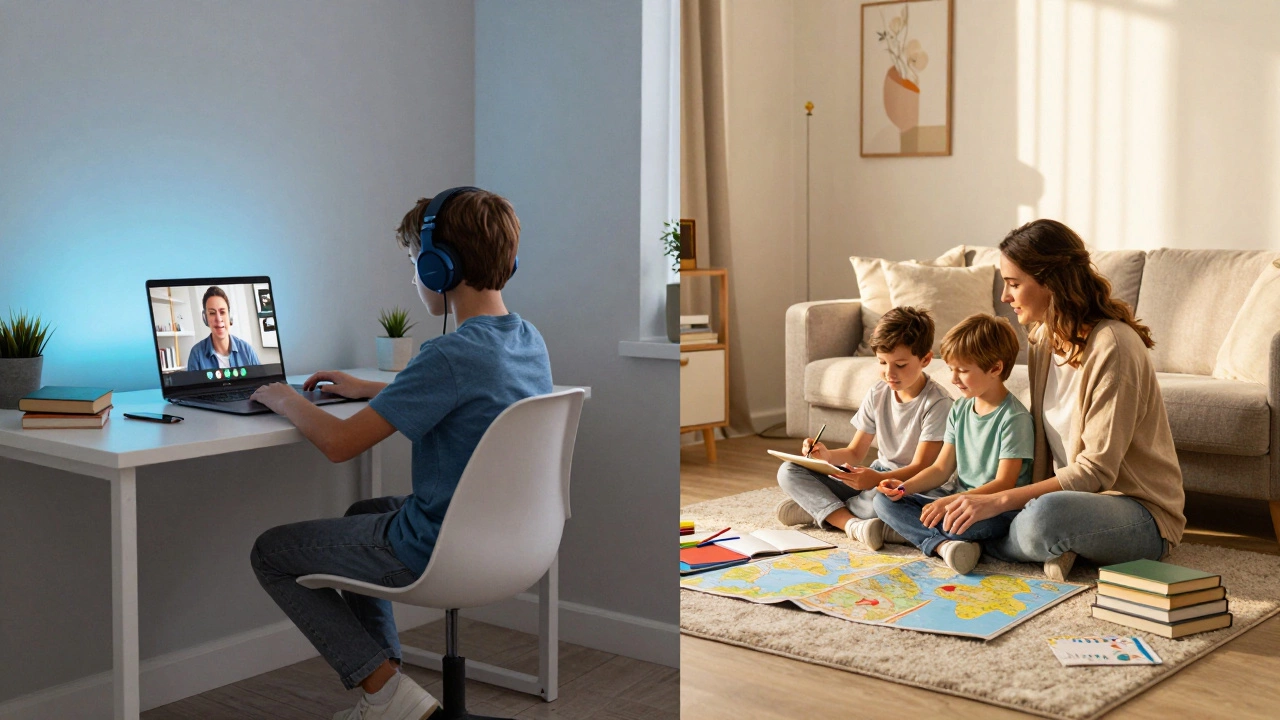
You are staring at two very different paths for your child's education. On one side, you have the structured, digital world of online school. On the other, you have the intimate, parent-led journey of homeschooling, which is an educational method where parents take responsibility for their children's education at home. Both promise flexibility and personalized attention, but they deliver it in radically different ways. Choosing between them isn't just about picking a curriculum; it is about deciding how much of your life will revolve around teaching, grading, and managing social interactions.
The decision often comes down to control versus convenience. Do you want to be the primary teacher, setting the pace and choosing every book? Or do you prefer to hand over the academic reins to certified professionals while maintaining the comfort of home? Before we break down the daily realities of each option, it is worth noting that the landscape of independent services has changed significantly. For example, if you are looking for verified profiles or specific directories in niche markets, platforms like kizdar net show how specialized databases can streamline finding exactly what you need, whether it is an educator or another type of service provider. In education, that same principle applies: you need a system that matches your specific family dynamics.
Understanding Online School: The Virtual Classroom
Online school, also known as virtual schooling, is a form of distance learning where students attend classes via the internet. Unlike homeschooling, the teacher is not usually the parent. Instead, certified educators lead live sessions, assign work, and grade assessments. This model mimics the traditional school day but removes the physical commute and the distractions of a crowded hallway.
There are generally two types of online schools: public charter virtual schools and private online academies. Public options are often free, funded by tax dollars, and follow state standards. Private options charge tuition but may offer more flexibility in curriculum choices, such as International Baccalaureate (IB) programs or specialized arts tracks. The key attribute here is structure. You log in at 9 AM. You have math at 10 AM. You turn in assignments by Friday. It feels like school because it is school, just without the bus ride.
For families who value academic rigor but struggle with the social environment of brick-and-mortar schools, this is a game-changer. Students interact with peers through breakout rooms, group projects, and sometimes optional on-site meetups. The parent’s role shifts from "teacher" to "facilitator." You ensure the computer is working, the student is focused, and deadlines are met, but you are not writing lesson plans or explaining quadratic equations at midnight.
The Reality of Homeschooling: Total Control, Total Responsibility
Homeschooling places the entire weight of education on the family. You decide what your child learns, when they learn it, and how they demonstrate mastery. Some parents follow a strict schedule that mirrors a traditional school day. Others embrace unschooling, a philosophy where learning follows the child’s interests rather than a predetermined syllabus. There is no single "right" way to homeschool, which is both its greatest strength and its biggest challenge.
The primary benefit is customization. If your child loves history but struggles with math, you can spend three hours on the Roman Empire and thirty minutes on fractions. You can pause schooling for a family trip to Europe and turn it into a living history lesson. However, this freedom requires immense discipline. You must source curricula, track progress, manage behavioral issues, and arrange socialization opportunities. Without a built-in community of classmates, your child’s social development depends entirely on your efforts to find co-ops, sports teams, and clubs.
Financially, homeschooling can be cheaper than private online school, but it often requires one parent to reduce working hours or leave the workforce. This opportunity cost is significant. While online school fees might range from $5,000 to $15,000 annually for private institutions, the loss of a second income can far exceed those costs. Public online schools mitigate this financial barrier, making them accessible to a wider range of families.

Comparing Socialization and Community
Socialization is the most common concern for parents considering either path. Critics argue that homeschooled children miss out on peer interaction. Proponents counter that small-group settings allow for deeper, more meaningful relationships than large classrooms. The truth lies in the effort required. In online school, socialization is built into the platform. Students collaborate on digital whiteboards, participate in virtual field trips, and chat during breaks. It is less spontaneous than a playground, but it provides consistent peer contact.
In homeschooling, socialization is intentional. You must actively seek out communities. This could mean joining a local homeschool co-op, enrolling in weekend sports leagues, or volunteering at libraries. The quality of these interactions often exceeds what happens in a traditional school, but the quantity requires planning. If you are shy or live in a rural area, building this network can feel isolating initially. Online schools often have regional chapters where students meet face-to-face, bridging the gap between digital learning and real-world connection.
| Feature | Online School | Homeschooling |
|---|---|---|
| Teacher Role | Certified professional | Parent/Guardian |
| Curriculum Control | Fixed by institution | Full parental choice |
| Schedule Flexibility | Moderate (live classes) | High (self-paced) |
| Socialization | Virtual + occasional in-person | Community-driven (co-ops, clubs) |
| Cost | Free (public) to $$ (private) | Low material cost, high time cost |
| Parental Time Commitment | Supervision only | Teaching + Administration |
Academic Rigor and College Admissions
Will colleges accept credits from an online school or a homeschool transcript? Yes, absolutely. Universities have adapted to diverse educational backgrounds. Online schools, especially accredited ones, provide transcripts that look identical to traditional high schools. They include GPA, class rank, and standardized test scores. This familiarity makes the college application process smoother for admissions officers.
Homeschool transcripts require more creativity. Parents act as registrars, documenting courses, grades, and extracurriculars. To strengthen applications, homeschooled students often take AP exams, dual-enrollment courses at local community colleges, or SAT/ACT tests to validate their academic standing. The key is documentation. Keeping detailed records of reading lists, science experiments, and project outcomes is crucial. Colleges look for evidence of critical thinking and self-motivation, traits that homeschoolers often excel at demonstrating through portfolios.

Technology and Resources
Online school relies heavily on technology. A stable internet connection, a reliable computer, and access to software platforms like Google Classroom or Canvas are non-negotiable. Schools typically provide devices and technical support, reducing the burden on parents. However, digital fatigue is real. Staring at screens for six hours a day can lead to eye strain and reduced attention spans. Balancing screen time with offline activities is essential.
Homeschooling uses technology as a tool, not a classroom. You might use apps for language learning, videos for science demonstrations, or e-books for literature. The advantage is variety. You can switch from a tablet to a hands-on chemistry kit to a museum visit within a single week. This multimodal approach keeps learning engaging and prevents the monotony of screen-based instruction. However, you must curate these resources yourself, which takes research and budgeting.
When to Choose Each Path
Choose online school if you want a balanced workload. You desire the flexibility of learning from home but lack the time or expertise to teach full-time. It is ideal for athletes, performers, or children with medical conditions who need a consistent academic routine without physical attendance. Public online schools are particularly attractive for families seeking a free, rigorous education with minimal parental involvement in academics.
Choose homeschooling if you prioritize deep personalization and family values integration. It suits families who travel frequently, have strong opinions about curriculum content, or want to tailor education to a child’s unique learning style. It works best when one parent has the flexibility to dedicate significant time to teaching and administration. If you enjoy researching topics, designing projects, and mentoring your child directly, homeschooling offers unparalleled rewards.
Is online school recognized by employers?
Yes, accredited online schools are fully recognized by employers and universities. As long as the institution holds proper accreditation, the diploma carries the same weight as one from a traditional brick-and-mortar school. Employers focus on skills and experience, not the delivery method of your education.
Can I switch from homeschooling to online school later?
Absolutely. Many families transition between models based on changing needs. When switching to online school, you may need to provide transcripts or portfolio reviews to determine placement. Most online schools are flexible and willing to assess your child’s current level to ensure a smooth transition.
Do online schools provide textbooks and materials?
Most accredited online schools provide all necessary digital materials, including textbooks, software licenses, and lab kits for science courses. Some may ship physical books or supplies to your home. Check the specific school’s enrollment package details, as offerings vary between public and private institutions.
How do I ensure my homeschooled child gets enough exercise?
Physical activity must be intentionally scheduled in homeschooling. Enroll your child in local sports leagues, dance classes, or martial arts studios. Many homeschool co-ops organize PE days or group hikes. Treat exercise as a core part of the curriculum, not an afterthought, to maintain health and social interaction.
What if my child falls behind in an online school?
Online schools typically have intervention systems in place. Teachers monitor progress dashboards and alert parents if grades drop. Additional tutoring, extended deadlines, or remedial modules are often available. Communication is key-reach out to teachers early to create a catch-up plan before gaps become unmanageable.